
 Алгебра
 Английский
 Биология
 География
 Геометрия
 История
 Русский
 Обществознание
 Физика
 Химия
Химия Информатика
 Литература
 Математика

§ Unit 1.3
Решебник по английскому языку язык 9 класс Биболетова Unit 1.3
Авторы:Биболетова
Год:2025
Тип:учебник
Серия:Enjoy English: Student's Book
Оглавление
- 66. Discuss the following questions. Try to use your own experience. (Обсуди следующие вопросы. Постарайся использовать свой собственный опыт.)
- 67. Match the words and their definitions. What type of roommate would you prefer? (Сопоставь слова и их определения. Какой тип соседа по комнате ты бы предпочел?)
- 68. Fill in the blanks with the words above. (Заполни пропуски словами выше.)
- 69. See Grammar Reference "The Structure of the Sentence" in Appendix 6, page 196 to make sure you remember how to ask questions. (См. Грамматический справочник "Структура предложения" в Приложении 6, страница 196, чтобы убедиться, что ты помнишь, как задавать вопросы.)
- 70. Listen and repeat how Curious Jack pronounces questions. Try to imitate his intonation. (Послушай и повтори, как Любопытный Джек произносит вопросы. Постарайся сымитировать его интонацию.)
- 71. Read the underlined pairs of questions with who in Ex. 70. Explain how they are different. (Прочитай выделенные пары вопросов с who в упр. 70. Объясни, чем они отличаются.)
- 72. Make up questions to match the answers. (Составь вопросы, чтобы они соответствовали ответам.)
- 73. Work in pairs. You are speaking on the phone. The line is not very good, so you can't hear all of the words and ask to repeat some information. Complete the dialogue asking questions to the words in bold (these are the words you didn't hear well). Act out the dialogue with your partner. (Поработайте в парах. Вы разговариваете по телефону. Линия очень плохая, поэтому вы не можете расслышать все слова и просите повторить информацию. Завершите диалог, задавая вопросы к выделенным словам (это слова, которые вы плохо расслышали). Разыграйте диалог со своим партнером.)
- 74. Listen to the recording and check your questions. Act out the dialogue. (Послушай запись и проверь свои вопросы. Разыграй диалог.)
- 75. Work in pairs. A distant relative is coming to stay with your family for a while. The relative lives in the United States and you've never seen this person before. Ask your elder sister (who has seen the relative) as many questions as possible to get an idea of whom you will be sharing your flat with. (Поработайте в парах. Дальний родственник приезжает пожить с вашей семьей на некоторое время. Родственник живет в Соединенных Штатах, и вы никогда не видели этого человека раньше. Задайте своей старшей сестре (которая видела родственника) как можно больше вопросов, чтобы составить представление о том, с кем вы будете делить свою квартиру.)
- 76. Work in pairs. Change your partner. Make up a dialogue using the questions from the exercise above. The beginning is done for you. (Поработайте в парах. Смените партнера. Составьте диалог, используя вопросы из предыдущего упражнения. Начало уже дано.)
- 77. Match the phrases with their definitions. (Сопоставь фразы с их определениями.)
- 78. Work in groups of 3 or 4. Read one of the texts and discuss the questions after it. Say what kind of person Sally, Sharon, Rick, and Daniel are. (Поработайте в группах по 3 или 4 человека. Прочитайте один из текстов и обсудите вопросы после него. Скажи, что за люди Салли, Шэрон, Рик и Дэниел.)
- 79. a) Ask the students in the other groups some questions to get the information about the teenagers you haven't read about. (You can use the questions after the text as well as your own.) Read the texts to check if the information is correct. (Задайте ученикам в других группах несколько вопросов, чтобы получить информацию о подростках, о которых вы не читали. (Ты можешь использовать вопросы после текста, а также свои собственные.) Прочитайте тексты, чтобы проверить, верна ли информация.)
- b) Use the phrases from the texts (Ex. 78) instead of the underlined expressions. (Используй фразы из текстов (Упр. 78) вместо подчеркнутых выражений.)
- 80. Say which one of the teenagers would be a good roommate. Which of them wouldn’t you like to share a room with? Explain why. (Скажи, кто из подростков был бы хорошим соседом по комнате. С кем из них ты не хотел бы делить комнату? Объясни почему.)
- 81. Read the list of the rules for sharing rooms that Rick worked out. Add 3 to 4 more rules. Write down the new rules. Discuss them. (Прочитай список правил для совместного проживания, которые выработал Рик. Добавь еще 3–4 правила. Запиши новые правила. Обсуди их.)
- 82. Listen to the dialogue and fill in the missing expressions from the box. Act out. (Послушай диалог и заполни пропущенные выражения из рамки. Разыграй.)
- 83. Listen to the questions and repeat. Copy the speaker's intonation. (Послушайте вопросы и повторите. Скопируйте интонацию говорящего.)
- 84. Work in groups. Imagine that you are going to study in a British boarding school (школа, где учащиеся не только учатся, но и живут) for a year. You will be sharing a room with one of your future classmates. You have the opportunity to ask him / her some questions to be sure that you will get on well together. Make up a list of questions. (Поработайте в группах. Представьте, что вы собираетесь учиться в британской школе-интернате (школа, где учащиеся не только учатся, но и живут) в течение года. Вы будете делить комнату с одним из ваших будущих одноклассников. У вас есть возможность задать ему / ей несколько вопросов, чтобы убедиться, что вы поладишь. Составьте список вопросов.)
- 85. Ask the students in other groups some questions from your list. Answer their questions. What questions were the most unexpected? (Задайте ученикам из других групп некоторые вопросы... Какие вопросы были самыми неожиданными?)
- 86. Describe the ideal roommate for you. Say what he/she should or shouldn't do to get on with you. (Опишите идеального соседа по комнате для вас. Скажите, что он/она должен или не должен делать, чтобы поладить с вами.)
- 87. Read, translate and learn. (Прочитай, переведи и выучи.)
- 88. Fill in the gaps. Use the prepositions that go with work / get / give. (Вставь пропущенные слова. Используй предлоги, которые употребляются с work / get / give.)
- 89. Six people want to stay at the hotel. You have to put (разместить) them into the rooms available. Listen to the people and write into the table as much information as possible about them. If you’ve missed any information, listen to the recording again. The table is in your Workbook. (Шесть человек хотят остановиться в отеле. Вы должны разместить их в имеющихся свободных комнатах. Прослушайте людей и запишите в таблицу как можно больше информации о них. Если вы пропустили какую-либо информацию, прослушайте запись еще раз. Таблица находится в вашей рабочей тетради.)
- 90. Working in groups, decide where to put each of the six people. (Работая в группах, решите, кого из шести человек куда поселить.)
§ Unit 1.3
66. Discuss the following questions. Try to use your own experience. (Обсуди следующие вопросы. Постарайся использовать свой собственный опыт.)
Have you ever lived apart from your family? When and where was it? (Ты когда-нибудь жил(а) вдали от своей семьи? Когда и где это было?)
Yes, I have. (Да.) I lived apart from my family last summer (прошлым летом) when I went to a summer camp (летний лагерь) for two weeks.
Have you ever been to a youth or a student camp? Did you enjoy living there? What did you like most and what did you dislike most? (Ты когда-нибудь был(а) в молодежном или студенческом лагере? Понравилось ли тебе там жить? Что тебе понравилось больше всего, а что меньше всего?)
Yes, I have been to a youth camp. (Да, я был в молодежном лагере.) I enjoyed living there (Мне понравилось там жить).
Liked most: I liked having loads of new friends, and we had a lot of fun and freedom.
Disliked most: I disliked the food and the fact that I couldn't rely on anyone when I felt down.
Do you feel all right when you are living apart from your family or do you miss them badly? (Ты чувствуешь себя хорошо, когда живешь вдали от семьи, или сильно по ним скучаешь?)
When I live apart, I feel independent (независимо), but I miss them badly (сильно по ним скучаю), especially my mum. I usually start to feel lonely after a few days.
Do you usually get on well with your roommates? (Ты обычно хорошо ладишь со своими соседями по комнате?)
Yes, I usually get on well with my roommates. (Да, обычно хорошо лажу.) I try to be calm and avoid conflicts. I also try to support them if they feel stressed out.
§ Unit 1.3
67. Match the words and their definitions. What type of roommate would you prefer? (Сопоставь слова и их определения. Какой тип соседа по комнате ты бы предпочел?)
a chatterbox (болтун) - d) someone who talks too much (тот, кто слишком много говорит).
a bookworm (книжный червь) - a) someone who reads a lot and spends all his / her time with books (тот, кто много читает и проводит все свое время с книгами).
a worrier (тревожный человек) - b) someone who worries a lot about everything (тот, кто много беспокоится обо всем).
a bore (зануда) - c) someone who is boring and who troubles people with boring things (тот, кто скучен и беспокоит людей скучными вещами).
§ Unit 1.3
67. Match the words and their definitions. What type of roommate would you prefer? (Сопоставь слова и их определения. Какой тип соседа по комнате ты бы предпочел?)
What type of roommate would you prefer? (Какой тип соседа по комнате ты бы предпочел?)
I would prefer a bookworm (книжного червя). (Я бы предпочел книжного червя.) I would also prefer someone who is calm and relaxed, and someone who does not talk too much. (Я бы также предпочел кого-то спокойного и расслабленного, и того, кто не слишком много говорит.) I can't stand a bore or a worrier. (Я не выношу зануду или тревожного человека.)
§ Unit 1.3
68. Fill in the blanks with the words above. (Заполни пропуски словами выше.)
Jane is a real bookworm. She spends all her time reading. (Джейн — настоящий книжный червь. Она тратит все свое время на чтение.)
Jack is a bore. He always speaks about dull and boring things and wants everybody to listen to him. (Джек — зануда. Он всегда говорит о скучных и нудных вещах и хочет, чтобы его все слушали.)
You can't fancy what a chatterbox Julia is. To her, living means talking. If we invite her to the party, we'll have to listen to her the whole evening. (Ты не можешь представить, какой болтушкой является Джулия. Для нее жить — значит говорить. Если мы пригласим ее на вечеринку, нам придется слушать ее весь вечер.)
Don't tell Jessica about your exam. She is such a worrier. She will worry a lot about it and will add to your troubles. (Не рассказывай Джессике о своем экзамене. Она такой тревожный человек. Она будет сильно переживать об этом и добавит тебе проблем.)
§ Unit 1.3Стр. 34
69. See Grammar Reference "The Structure of the Sentence" in Appendix 6, page 196 to make sure you remember how to ask questions. (См. Грамматический справочник "Структура предложения" в Приложении 6, страница 196, чтобы убедиться, что ты помнишь, как задавать вопросы.)
Это задание является информационным указанием и не требует письменного ответа в тетради, кроме как прочитать и принять к сведению, что нужно повторить грамматический справочник для проверки правил построения вопросов.
§ Unit 1.3Стр. 34
70. Listen and repeat how Curious Jack pronounces questions. Try to imitate his intonation. (Послушай и повтори, как Любопытный Джек произносит вопросы. Постарайся сымитировать его интонацию.)
Present Simple: Do you sometimes quarrel with your friends? (Ты иногда ссоришься со своими друзьями?)
Present Continuous: Are you speaking to Jessica? (Ты разговариваешь с Джессикой?)
Present Perfect: Have you ever quarrelled with your best friend? (Ты когда-нибудь ссорился со своим лучшим другом?)
Present Perfect Continuous: Have you been waiting for Ken? (Ты ждал Кена?)
§ Unit 1.3Стр. 35
71. Read the underlined pairs of questions with who in Ex. 70. Explain how they are different. (Прочитай выделенные пары вопросов с who в упр. 70. Объясни, чем они отличаются.)
Who quarrels with you? (Кто ссорится с тобой?) - Who is your best friend? (Кто твой лучший друг?)
Who are you speaking to? (С кем ты разговариваешь?) - Who is speaking to you? (Кто разговаривает с тобой?)
Who have you quarrelled with? (С кем ты поссорился?) - Who has quarrelled with Ken? (Кто поссорился с Кеном?)
Who have you been speaking to for an hour already? (С кем ты разговариваешь уже час?) - Who has been speaking to you for so long? (Кто разговаривает с тобой так долго?)
1-я колонка (Who/What as an object - дополнение): Вопросы, в которых Who выступает в роли дополнения (объекта) действия. В этих вопросах используется вспомогательный глагол (например, do, are, have). (Например, Who are you speaking to? — ты совершаешь действие).
2-я колонка (Who/What as a subject - подлежащее): Вопросы, в которых Who выступает в роли подлежащего (субъекта) действия. В этих вопросах вспомогательный глагол не используется (кроме to be или модальных глаголов). Структура вопроса совпадает со структурой утвердительного предложения в соответствующем времени. (Например, Who is speaking to you? — неизвестный совершает действие).
§ Unit 1.3Стр. 35
72. Make up questions to match the answers. (Составь вопросы, чтобы они соответствовали ответам.)
"No, I don't. I think all these stories about ghosts are just silly talks." (Нет. Я думаю, все эти истории о призраках — просто глупые разговоры.)
- Do you believe in ghosts? (Ты веришь в призраков?)
"Yes, the water is lovely today." (Да, вода сегодня прекрасная.)
- Is your hair wet, (have you been swimming)? (У тебя мокрые волосы, (ты плавал?)?)
"Nor yet. I have been busy with my homework." (Или еще нет. Я был занят домашней работой.)
- Have you taken out the rubbish, (did you do it)? (Ты вынес мусор, (ты сделал это?)?)
"No, for five minutes or so. I was late myself actually." (Нет, около пяти минут. Я сам опоздал на самом деле.)
- Have you been waiting for a long time? (Ты долго ждал?)
"No, the day after tomorrow. It means we have one more day." (Нет, послезавтра. Это значит, у нас есть еще один день.)
- Is it a shame that your holiday is almost over (is it leaving tomorrow)? (Разве не обидно, что твой отпуск почти закончился (он завтра заканчивается?)?)
§ Unit 1.3Стр. 35
73. Work in pairs. You are speaking on the phone. The line is not very good, so you can't hear all of the words and ask to repeat some information. Complete the dialogue asking questions to the words in bold (these are the words you didn't hear well). Act out the dialogue with your partner. (Поработайте в парах. Вы разговариваете по телефону. Линия очень плохая, поэтому вы не можете расслышать все слова и просите повторить информацию. Завершите диалог, задавая вопросы к выделенным словам (это слова, которые вы плохо расслышали). Разыграйте диалог со своим партнером.)
Harry: Hello!
You: Hi, Who did I catch the name?
Harry: This is Harry, remember? We met in Liverpool.
You: Pardon? Where did we meet?
Harry: L-i-v-e-r-p-o-o-l. We went to the rock concert together.
You: ...? What did we go to together?
Harry: To the rock concert. We were wearing white jeans and a T-shirt.
You: What were we wearing?
Harry: White. You looked gorgeous in them. Especially when you were climbing up on the stage. You wanted to borrow the micro-phone.
You: ...? What did I want to borrow?
Harry: The micro-phone. Look here, I’ve never been to Liverpool. I’m not keen on rock music at all. And I don’t wear white jeans.
You: Pardon? Then Who have you been wasting my time and asking all these silly questions? (pause) So could we still meet tonight anyway?
§ Unit 1.3Стр. 35
74. Listen to the recording and check your questions. Act out the dialogue. (Послушай запись и проверь свои вопросы. Разыграй диалог.)
Harry: Hello! You: Hi, Who did I catch the name? (Привет, Чье имя я не расслышал?) Harry: This is Harry, remember? We met in Liverpool. You: Pardon? Where did we meet? (Простите? Где мы встретились?) Harry: L-i-v-e-r-p-o-o-l. We went to the rock concert together. You: ...? What did we go to together? (Что...? Что мы посетили вместе?) Harry: To the rock concert. We were wearing white jeans and a T-shirt. You: What were we wearing? (Во что мы были одеты?) Harry: White. You looked gorgeous in them. Especially when you were climbing up on the stage. You wanted to borrow the micro-phone. You: ...? What did I want to borrow? (Что...? Что я хотел занять?) Harry: The micro-phone. Look here, I’ve never been to Liverpool. I’m not keen on rock music at all. And I don’t wear white jeans. You: Pardon? Then Who have you been wasting my time and asking all these silly questions? (pause) So could we still meet tonight anyway?
§ Unit 1.3Стр. 36
75. Work in pairs. A distant relative is coming to stay with your family for a while. The relative lives in the United States and you've never seen this person before. Ask your elder sister (who has seen the relative) as many questions as possible to get an idea of whom you will be sharing your flat with. (Поработайте в парах. Дальний родственник приезжает пожить с вашей семьей на некоторое время. Родственник живет в Соединенных Штатах, и вы никогда не видели этого человека раньше. Задайте своей старшей сестре (которая видела родственника) как можно больше вопросов, чтобы составить представление о том, с кем вы будете делить свою квартиру.)
Is it a man or a woman? (Это мужчина или женщина?)
How old is he / she? (Сколько ему/ей лет?)
What does he / she look like (appearance, tall, short, handsome, beard, colour of hair, etc.)? (Как он/она выглядит (внешность, высокий, низкий, красивый, борода, цвет волос и т. д.)?)
Does he / she speak Russian (languages)? (Он/она говорит по-русски (языки?)?)
How long has he / she been living in America? (Как долго он/она живет в Америке?)
Does he / she have a family? (У него/нее есть семья?)
Does he / she have any kids? (У него/нее есть дети?)
What is his / her job? (Какая у него/нее работа?)
What are his / her traits of character (nice, moody, gets up early in the morning, enjoys sport, etc.)? (Какие у него/нее черты характера (милый, капризный, рано встает, любит спорт и т. д.)?)
Does he / she smoke (smokes)? (Он/она курит (курит?)?)
How long is he / she staying at your place? (Как долго он/она будет жить у вас?)
§ Unit 1.3Стр. 36
76. Work in pairs. Change your partner. Make up a dialogue using the questions from the exercise above. The beginning is done for you. (Поработайте в парах. Смените партнера. Составьте диалог, используя вопросы из предыдущего упражнения. Начало уже дано.)
Mum: Hi, dear! I’ve got good news for you. We are receiving a guest tonight. It’s a relative from America. I think you should tidy up your room, don’t you? (Привет, дорогой! У меня для тебя хорошие новости. Мы принимаем гостя сегодня вечером. Это родственник из Америки. Думаю, тебе стоит убрать свою комнату, не так ли?)
You: Yes, Mum. But it’s a little bit unexpected, isn’t it? Let me know at least who this is... (Скажи мне хотя бы, кто это...)
Mum: It's your Aunt Susan, dear.
You: Aunt Susan? Is she a man or a woman? (Тетя Сьюзан? Это мужчина или женщина?)
Mum: A woman, of course!
You: How long is she staying at your place? (Как долго она будет жить у нас?)
Mum: She is staying for a whole month.
You: A month! Does she smoke? (Месяц! Она курит?)
Mum: No, she doesn't. And she is very calm and doesn't talk too much. (Нет. И она очень спокойная и не слишком много говорит.)
You: Sounds OK to me! (Мне это кажется нормальным!)
§ Unit 1.3Стр. 36
77. Match the phrases with their definitions. (Сопоставь фразы с их определениями.)
to spoil the impression (испортить впечатление) - b) to make somebody feel less happy and enthusiastic about something (заставить кого-то чувствовать себя менее счастливым и восторженным чем-то).
to have a chance to escape from (иметь возможность сбежать от) - e) to have the hope of avoiding something (иметь надежду избежать чего-то).
to observe the law of co-existence (соблюдать закон сосуществования) - f) to follow certain rules of behaviour that help avoid quarrels (следовать определенным правилам поведения, которые помогают избежать ссор).
to do something at other people’s expense (делать что-то за чужой счет) - c) to do something that breaks other people’s rights, independence, comfort (делать что-то, что нарушает права, независимость, комфорт других людей).
to make a fuss about something (поднимать шум из-за чего-то) - d) to be nervous about unimportant things, talk a lot about them, or try to do something but without a good result (нервничать из-за неважных вещей, много говорить о них или пытаться что-то сделать без хорошего результата).
to work out (вырабатывать, решать) - a) to make, to create, to develop (делать, создавать, развивать).
§ Unit 1.3Стр. 37
Text A (Sally)
What kind of girl was Sally’s roommate, according to Sally’s words? (Что за девушка была соседкой Салли, по словам Салли?)
Sally's roommate was a cute (симпатичная) girl but a real chatterbox (настоящая болтушка). She spent her time talking about clothes and boys (говоря о одежде и парнях). She was annoying (раздражающая).
Why did Sally tell her roommate unpleasant things? (Почему Салли говорила соседке неприятные вещи?)
Sally told her roommate unpleasant things because she was mad (злая) and the sound of her voice seemed very annoying (казался очень раздражающим). Sally felt jealous (чувствовала ревность) when the roommate talked about the boy she liked.
Do you approve of Sally’s behaviour? (Ты одобряешь поведение Салли?)
I do not approve of Sally's behaviour. (Я не одобряю поведение Салли.) She should not have told her that her clothes looked stupid and she should have avoided conflicts (ей не следовало говорить ей, что ее одежда выглядит глупо, и она должна была избегать конфликтов). She should have remembered that we should not do anything that hurts the roommate.
What kind of person is Sally? (Что за человек Салли?)
Sally is a person who is interested in studying and learning (заинтересована в учебе), but she is also moody (капризная), jealous (ревнивая) and easily annoyed (легко раздражается).
What advantages does Sharon see in sharing a room? (Какие преимущества Шэрон видит в совместном проживании?)
Sharon thinks sharing a room is a great experience (отличный опыт) that teaches you to live in the world of adults (жить во взрослом мире). You learn to take care of yourself (заботиться о себе) and not depend on your parents.
What is Sharon’s law of co-existence? (В чем заключается закон сосуществования Шэрон?)
The law of co-existence (закон сосуществования) is very simple: you can do anything you like but not at other people’s expense (за чужой счет). In other words, you can enjoy yourself as long as it doesn’t hurt other people.
Do you think observing this law can make sharing easy and trouble-free? (Ты думаешь, соблюдение этого закона может сделать совместное проживание легким и беспроблемным?)
Yes, I think so. (Да, думаю, да.) If both roommates observe the law (соблюдают закон), they will avoid quarrels (избегать ссор) and make their life all right (в полном порядке).
What kind of person is Sharon? (Что за человек Шэрон?)
Sharon is a wise (мудрая), reasonable (разумная) person who values independence (независимость) and respect (уважение).
What attracts Daniel to sharing a room with a person his age? (Что привлекает Дэниела в совместном проживании с человеком его возраста?)
Daniel is attracted to sharing a room because it is great fun (это очень весело) and it means he can do whatever he wants (может делать все, что хочет). He is not controlled by his parents.
What does he think about tidiness? (Что он думает о чистоте?)
Daniel doesn't think teenagers care about tidiness at all (не думает, что подростки вообще заботятся о чистоте). He says parents make a fuss about tidiness (поднимают шум из-за чистоты), but he is not annoyed by clothes on the sofa or even under it.
Do you think he is a good or a bad roommate? Why? (Ты думаешь, он хороший или плохой сосед по комнате? Почему?)
I think Daniel could be a bad roommate (может быть плохим соседом). While he is fun, his lack of care for tidiness (отсутствие заботы о чистоте) and his belief that he can do whatever he wants (делать все, что хочет) might spoil the impression (испортить впечатление) and break other people’s comfort (нарушить комфорт других людей).
What kind of person is Daniel? (Что за человек Дэниел?)
Daniel is a relaxed (расслабленный), fun (веселый) person who values freedom (свободу), but he is also untidy (неопрятный) and dislikes rules (не любит правила).
How does Rick feel about sharing a room with seven boys? (Что Рик думает о совместном проживании с семью парнями?)
Rick thinks it’s not easy (это нелегко) when there are so many people with different personalities (личностями). However, he lived apart from his family (жил вдали от семьи) at a sports camp, and he sees it as a great experience.
What’s his secret for sharing a room without quarrels? (В чем его секрет совместного проживания без ссор?)
Rick's secret is that they worked out a list of rules (выработали список правил) that helped them avoid quarrels (избежать ссор).
Can you add anything to his list of the rules? (Ты можешь что-нибудь добавить в его список правил?)
Rick's List of Rules:
Don’t speak too loudly and don’t play loud music in the room.
Don’t occupy the toilet or the bathroom for more than ten minutes.
Don’t ask too many questions if someone wants to be left alone for a while.
My addition: You should clean up your dishes immediately after eating. (Ты должен сразу убирать свою посуду после еды.)
My addition: You should ask your roommate before inviting guests. (Ты должен спросить своего соседа перед тем, как приглашать гостей.)
What kind of person is Rick? (Что за человек Рик?)
Rick is a disciplined (дисциплинированный) person who believes in rules and cooperation (сотрудничество) to solve problems.
§ Unit 1.3Стр. 39
79. a) Ask the students in the other groups some questions to get the information about the teenagers you haven't read about. (You can use the questions after the text as well as your own.) Read the texts to check if the information is correct. (Задайте ученикам в других группах несколько вопросов, чтобы получить информацию о подростках, о которых вы не читали. (Ты можешь использовать вопросы после текста, а также свои собственные.) Прочитайте тексты, чтобы проверить, верна ли информация.)
What did Sally dislike most about her roommate? (Что Салли не нравилось больше всего в ее соседке?)
What is Sharon’s "law of co-existence"? (В чем состоит "закон сосуществования" Шэрон?)
What attracts Daniel to sharing a room? (Что привлекает Дэниела в совместном проживании?)
What was Rick’s secret for sharing a room without quarrels? (В чем был секрет Рика для совместного проживания без ссор?)
§ Unit 1.3Стр. 39
b) Use the phrases from the texts (Ex. 78) instead of the underlined expressions. (Используй фразы из текстов (Упр. 78) вместо подчеркнутых выражений.)
In general, I enjoyed our holiday at the seaside but several days of nasty weather made us feel less happy.
- In general, I enjoyed our holiday at the seaside but several days of nasty weather made us spoil the impression. (Испортить впечатление.)
Though I felt tired and sleepy and didn't listen to Jim, he talked and talked about his recent quarrel with his girlfriend.
- Though I felt tired and sleepy and didn't listen to Jim, he made a fuss about something about his recent quarrel with his girlfriend. (Поднять шум из-за чего-то.)
As we are not your parents, we are not going to wash your clothes and forgive the mess in this room.
- As we are not your parents, we are not going to wash your clothes and do something at other people’s expense in this room. (Делать что-то за чужой счет.)
Adults always speak too much and pay too much attention to unimportant things like housework.
- Adults always speak too much and make a fuss about tidiness like housework. (Поднимают шум из-за чистоты.)
If you share a room, the easiest way to avoid quarrels with your roommate is to follow reasonable rules in everyday life.
- If you share a room, the easiest way to avoid quarrels with your roommate is to observe the law of co-existence. (Соблюдать закон сосуществования.)
§ Unit 1.3Стр. 39
80. Say which one of the teenagers would be a good roommate. Which of them wouldn’t you like to share a room with? Explain why. (Скажи, кто из подростков был бы хорошим соседом по комнате. С кем из них ты не хотел бы делить комнату? Объясни почему.)
-
Good Roommate: Sharon or Rick.
Sharon is a good roommate because she observes the law of co-existence. She understands that you can enjoy yourself as long as it doesn’t hurt other people.
Rick is a good roommate because he worked out a list of rules to avoid quarrels and ensures that everyone is comfortable.
-
Bad Roommate: Sally or Daniel.
Sally is a bad roommate because she is a chatterbox (болтушка) and is easily annoyed (раздражается), and she tells unpleasant things (говорит неприятные вещи) to her roommate. This would spoil the impression of sharing a room.
Daniel is a bad roommate because he doesn't care about tidiness at all (вообще не заботится о чистоте) and would likely do something at other people's expense by leaving his clothes everywhere.
§ Unit 1.3Стр. 39
Rick's Rules (Правила Рика):
Don’t speak too loudly and don’t play loud music in the room if it’s not a party (because there might be somebody who feels sleepy or who is trying to concentrate on reading or something like that).
Don’t occupy the toilet or the bathroom for more than ten minutes.
Don’t ask too many questions if someone wants to be left alone for a while.
We should work out a timetable (выработать расписание) for cleaning the room.
We should cheer somebody up (подбодрить кого-то), not ignore, if he / she is feeling down.
We should appreciate something (ценить что-то), not to make a fuss about (поднимать шум из-за) tidiness.
We should always ask for permission (спрашивать разрешение) before inviting guests.
§ Unit 1.3Стр. 39
82. Listen to the dialogue and fill in the missing expressions from the box. Act out. (Послушай диалог и заполни пропущенные выражения из рамки. Разыграй.)
Заполняем пропуски выражениями из рамки:
— I don’t mind... What do you say? (Я не возражаю... Что ты скажешь?)
— I have... but can I ask you some questions?
— Sure. (Конечно.)
— Do you play any musical instruments?
— ... you know. (... ты знаешь.)
— Yes, I play the guitar. But I can play it only when you are out if you like. (Да, я играю на гитаре. Но я могу играть, только когда ты уйдешь, если хочешь.)
— I don’t like going out in the evening. (Мне не нравится выходить вечером.)
— We go out together, shall we? (Мы пойдем гулять вместе, ладно?)
— OK. But I don’t like noisy parties.
— ..., aren't I?
— Nothing of the kind! ...if you like. (Ничего подобного!... если хочешь.)
§ Unit 1.3Стр. 40
83. Listen to the questions and repeat. Copy the speaker's intonation. (Послушайте вопросы и повторите. Скопируйте интонацию говорящего.)
Does your roommate get up early or late? (Твой сосед по комнате встает рано или поздно?) (Альтернативный вопрос с "or". Интонация повышается на early и понижается на late.)
Is your roommate a chatterbox or a bookworm? (Твой сосед по комнате — болтун или книжный червь?) (Альтернативный вопрос с "or". Интонация повышается на chatterbox и понижается на bookworm.)
Do you share a room with someone in the family or do you have a room of your own? (Ты делишь комнату с кем-то из семьи или у тебя есть своя собственная комната?) (Альтернативный вопрос с "or". Интонация повышается на family и понижается на room of your own.)
Are you sleeping or listening to the music at the moment? (Ты спишь или слушаешь музыку в данный момент?) (Альтернативный вопрос с "or". Интонация повышается на sleeping и понижается на the music.)
You look up_, set. Have you had a quarrel with your friends or with your parents? (Ты выглядишь расстроенным. У тебя была ссора с друзьями или с родителями?) (Альтернативный вопрос с "or". Интонация повышается на friends и понижается на parents.)
§ Unit 1.3Стр. 40
84. Work in groups. Imagine that you are going to study in a British boarding school (школа, где учащиеся не только учатся, но и живут) for a year. You will be sharing a room with one of your future classmates. You have the opportunity to ask him / her some questions to be sure that you will get on well together. Make up a list of questions. (Поработайте в группах. Представьте, что вы собираетесь учиться в британской школе-интернате (школа, где учащиеся не только учатся, но и живут) в течение года. Вы будете делить комнату с одним из ваших будущих одноклассников. У вас есть возможность задать ему / ей несколько вопросов, чтобы убедиться, что вы поладишь. Составьте список вопросов.)
Список вопросов:
What time do you usually go to bed and wake up? (Во сколько ты обычно ложишься спать и просыпаешься?)
Do you mind if I open the window when the room is too hot? (Ты не против, если я открою окно, когда в комнате слишком жарко?)
Are you a tidy person, or do you leave your things everywhere? (Ты аккуратный человек или оставляешь свои вещи везде?)
Do you like inviting people to the room often? (Тебе нравится часто приглашать людей в комнату?)
Do you need silence for studying, or is some background noise okay? (Тебе нужна тишина для учебы, или какой-то фоновый шум допустим?)
Are you comfortable sharing things like a kettle or an iron? (Тебе комфортно делиться такими вещами, как чайник или утюг?)
Is your phone usually set to vibrate, or does it ring loudly? (Твой телефон обычно стоит на вибрации или громко звонит?)
§ Unit 1.3Стр. 40
85. Ask the students in other groups some questions from your list. Answer their questions. What questions were the most unexpected? (Задайте ученикам из других групп некоторые вопросы... Какие вопросы были самыми неожиданными?)
What questions were the most unexpected? (Какие вопросы были самыми неожиданными?)
The most unexpected question was: "What is the first thing you do when you get up in the morning?" (Самым неожиданным вопросом был: "Что ты делаешь первым делом, когда просыпаешься утром?")
My answer was: "I immediately check my phone for messages and then go brush my teeth." (Мой ответ был: "Я сразу же проверяю телефон на наличие сообщений, а затем иду чистить зубы.")
§ Unit 1.3Стр. 40
86. Describe the ideal roommate for you. Say what he/she should or shouldn't do to get on with you. (Опишите идеального соседа по комнате для вас. Скажите, что он/она должен или не должен делать, чтобы поладить с вами.)
My ideal roommate should be considerate and respectful. (Мой идеальный сосед по комнате должен быть внимательным и уважительным.)
He/She should be organised and keep his/her own area clean. He shouldn't leave food or dirty dishes in the room, as this can attract insects. (Он/Она должен быть организованным и содержать свою территорию в чистоте. Он не должен оставлять еду или грязную посуду в комнате, так как это может привлечь насекомых.)
He/She should respect my studying time. He shouldn't play music without headphones, and should always ask before bringing guests into the room, especially late in the evening. (Он/Она должен уважать мое учебное время. Он не должен включать музыку без наушников и должен всегда спрашивать разрешения, прежде чем приводить гостей в комнату, особенно поздно вечером.)
We should be able to communicate openly. If there is a problem, he/she shouldn't get angry but should talk about it calmly so we can find a solution that works for both of us. (Мы должны быть в состоянии открыто общаться. Если возникнет проблема, он/она не должен сердиться, а должен поговорить об этом спокойно, чтобы мы могли найти решение, подходящее для нас обоих.)
§ Unit 1.3Стр. 41
87. Read, translate and learn. (Прочитай, переведи и выучи.)
We worked out a plan for our holiday trip. (Мы разработали план нашей поездки на каникулы.)
For two weeks I’ve been working on a funny newspaper for my dad’s birthday. (Две недели я работаю над забавной газетой ко дню рождения моего папы.)
Who would you like to work with: Rick or Sharon? (С кем бы ты хотел работать: с Риком или с Шэрон?)
My sister-in-law works for a well-known foreign company. (Моя невестка работает в известной иностранной компании.)
She gets on with anyone. She’s an ideal roommate. (Она ладит со всеми. Она идеальная соседка по комнате.)
Why do you get up so early? (Почему ты встаёшь так рано?)
Get out of here! This place is not for walking dogs. (Убирайся отсюда! Здесь нельзя выгуливать собак.)
I know Dick pretty well. I think we’ll be able to get along. (Я хорошо знаю Дика. Думаю, мы сможем поладить.)
My cousin, who is sharing a room with me at the moment, has given up smoking. (Мой двоюродный брат, который сейчас живёт со мной в одной комнате, бросил курить.)
My new friend is not reliable. He keeps giving away my secrets. (Мой новый друг ненадёжен. Он постоянно выдаёт мои секреты.)
The American Olympic team gave in after all. (Американская олимпийская команда всё же сдалась.)
§ Unit 1.3Стр. 41
88. Fill in the gaps. Use the prepositions that go with work / get / give. (Вставь пропущенные слова. Используй предлоги, которые употребляются с work / get / give.)
1. How long has she been working for this company? (Как долго она работает на эту компанию?)
2. Cathy has been working on her essay for two weeks already. She is going to take part in a contest for young writers. (Кэти работает над своим сочинением уже две недели. Она собирается участвовать в конкурсе юных писателей.)
3. When people share a room, the best way to avoid quarrels is to work out a set of rules everybody should observe. (Когда люди живут в одной комнате, лучший способ избежать ссор — разработать набор правил, которых все должны придерживаться.)
4. Get out of my room! I don’t want to listen to you any longer. (Убирайся из моей комнаты! Я больше не хочу тебя слушать.)
5. I’ll never forgive you if you give away my secret. (Я тебя никогда не прощу, если ты раскроешь мой секрет.)
6. Sally and Julia have been sharing a room for two years. They get on with each other and never quarrel, actually. (Салли и Джулия живут в одной комнате уже два года. Они ладят друг с другом и, на самом деле, никогда не ссорятся.)
§ Unit 1.3Стр. 41
89. Six people want to stay at the hotel. You have to put (разместить) them into the rooms available. Listen to the people and write into the table as much information as possible about them. If you’ve missed any information, listen to the recording again. The table is in your Workbook. (Шесть человек хотят остановиться в отеле. Вы должны разместить их в имеющихся свободных комнатах. Прослушайте людей и запишите в таблицу как можно больше информации о них. Если вы пропустили какую-либо информацию, прослушайте запись еще раз. Таблица находится в вашей рабочей тетради.)
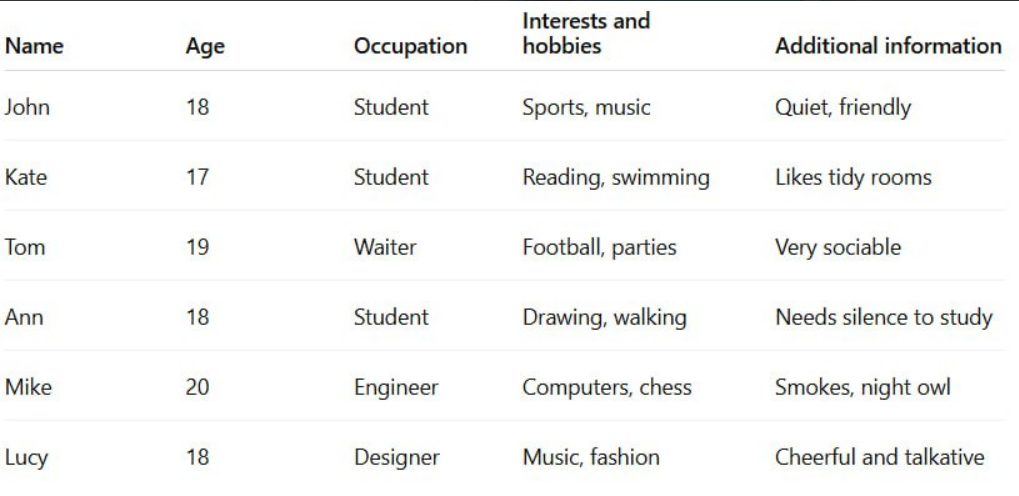
§ Unit 1.3Стр. 41
90. Working in groups, decide where to put each of the six people. (Работая в группах, решите, кого из шести человек куда поселить.)
Room 1: John and Tom — both like sports and are sociable. (Комната 1: Джон и Том — оба любят спорт и общительны.)
Room 2: Kate and Ann — both quiet and like studying. (Комната 2: Кейт и Энн — обе спокойные и любят учиться.)
Room 3: Mike and Lucy — both creative and like computers/music. (Комната 3: Майк и Люси — оба творческие, любят музыку и технологии.)
Explanation: They have common interests and will not disturb each other. (У них общие интересы, и они не будут мешать друг другу.)
Поделись с друзьями
