
 Алгебра
 Английский
 Биология
 География
 Геометрия
 История
 Русский
 Обществознание
 Физика
 Химия
Химия Информатика
 Литература
 Математика
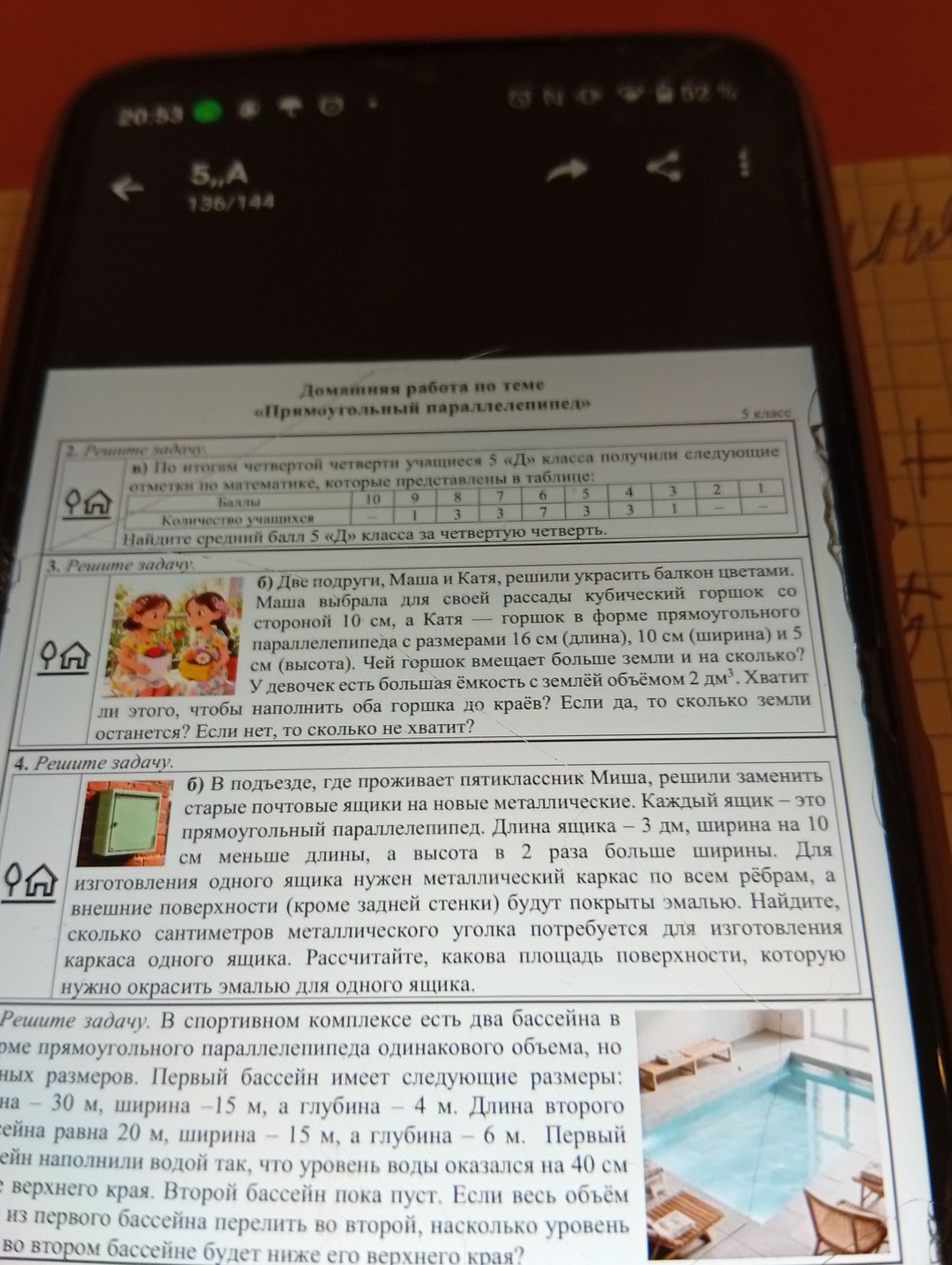
4. Решите задачу. б) В подъезде, где проживает пятиклассник Миша, решили заменить старые почтовые ящики на новые металлические. Каждый ящик - это прямоугольный параллелепипед. Длина ящика 3 дм, ширина на 10 см меньше длины, а высота в 2 раза больше ширины. Для изготовления одного ящика нужен металлический каркас по всем рёбрам, а внешние поверхности (кроме задней стенки) будут покрыты эмалью. Найдите, сколько сантиметров металлического уголка потребуется для изготовления каркаса одного ящика. Рассчитайте, какова площадь поверхности, которую нужно окрасить эмалью для одного ящика.
Ответ:
Решение:
1. Найдем размеры ящика в сантиметрах:
Длина \( l = 3 \) дм = \( 30 \) см.
Ширина \( w = l - 10 \) см = \( 30 - 10 = 20 \) см.
Высота \( h = 2 \cdot w \) см = \( 2 \cdot 20 = 40 \) см.
2. Найдем длину металлического уголка (периметр всех ребер):
У параллелепипеда 12 ребер: 4 длины, 4 ширины, 4 высоты.
Периметр \( P = 4l + 4w + 4h \)
\[ P = 4 \cdot 30 + 4 \cdot 20 + 4 \cdot 40 \]
\[ P = 120 + 80 + 160 = 360 \) см.
3. Найдем площадь поверхности, которую нужно окрасить (без задней стенки):
Площадь всей поверхности параллелепипеда \( S_{полн} = 2(lw + lh + wh) \).
Площадь задней стенки \( S_{задн} = w \cdot h \).
Площадь для окраски \( S_{окр} = S_{полн} - S_{задн} = 2(lw + lh + wh) - wh \) = \( 2lw + 2lh + 2wh - wh = 2lw + 2lh + wh \).
ИЛИ можно посчитать площади отдельно:
Передняя стенка: \( l \cdot h = 30 \cdot 40 = 1200 \) см².
Боковые стенки (2 шт.): \( w \cdot h = 20 \cdot 40 = 800 \) см² каждая. Итого: \( 2 \cdot 800 = 1600 \) см².
Верхняя и нижняя стенки (2 шт.): \( l \cdot w = 30 \cdot 20 = 600 \) см² каждая. Итого: \( 2 \cdot 600 = 1200 \) см².
Задняя стенка (не красится): \( w \cdot h = 20 \cdot 40 = 800 \) см².
Общая площадь для окраски: \( 1200 \) (передняя) + \( 1600 \) (боковые) + \( 1200 \) (верх/низ) = \( 4000 \) см².
Проверка по формуле:
\[ S_{окр} = 2 \cdot (30 \cdot 10) + 2 \cdot (30 \cdot 5) + (10 \cdot 5) \] (применяя размеры из условия, а не вычисленные)
Oops, the problem states the dimensions differently for the painting calculation. Let's re-evaluate the painting surface area based on the *dimensions derived earlier* for the metal frame: l=30 cm, w=20 cm, h=40 cm.
The surfaces to be painted are:
- Front: \( l \times h = 30 \times 40 = 1200 \) cm²
- Top: \( l \times w = 30 \times 20 = 600 \) cm²
- Bottom: \( l \times w = 30 \times 20 = 600 \) cm²
- Two Sides: \( w \times h = 20 \times 40 = 800 \) cm² each, total \( 1600 \) cm²
Total painted area = \( 1200 + 600 + 600 + 1600 = 4000 \) cm².
Let's re-read the question carefully: "внешние поверхности (кроме задней стенки) будут покрыты эмалью." The dimensions are: length 3 dm (30cm), width 10cm less than length (20cm), height 2 times the width (40cm).
The surfaces are:
- Front: \( 30 \times 40 = 1200 \) cm²
- Top: \( 30 \times 20 = 600 \) cm²
- Bottom: \( 30 \times 20 = 600 \) cm²
- Side 1: \( 20 \times 40 = 800 \) cm²
- Side 2: \( 20 \times 40 = 800 \) cm²
- Back (not painted): \( 20 \times 40 = 800 \) cm²
Total area to be painted: \( 1200 + 600 + 600 + 800 + 800 = 4000 \) cm².
Let's try to use the formula for the lateral surface area plus the top and bottom, excluding one side.
Lateral surface area = \( 2(l+w)h = 2(30+20)40 = 2(50)40 = 4000 \) cm².
Area of top and bottom = \( 2lw = 2(30)(20) = 1200 \) cm².
Total surface area = \( 4000 + 1200 = 5200 \) cm².
Area to be painted = Total surface area - Area of back side.
The back side is \( w \times h = 20 \times 40 = 800 \) cm².
So, Area to be painted = \( 5200 - 800 = 4400 \) cm².
Let's check the problem again. "Длина ящика 3 дм, ширина на 10 см меньше длины, а высота в 2 раза больше ширины."
l = 30 cm
w = 30 - 10 = 20 cm
h = 2 * 20 = 40 cm
The surfaces of a rectangular parallelepiped are:
- Front: l * h = 30 * 40 = 1200 cm²
- Back: l * h = 30 * 40 = 1200 cm² (this is usually the back if length is the longer dimension on the front)
- Top: l * w = 30 * 20 = 600 cm²
- Bottom: l * w = 30 * 20 = 600 cm²
- Left Side: w * h = 20 * 40 = 800 cm²
- Right Side: w * h = 20 * 40 = 800 cm²
The problem states "кроме задней стенки". It's ambiguous which face is the "задняя" (back) face. Common convention would be the face opposite the front. If the front is \( l \times h \), then the back is also \( l \times h \). But if the problem means one of the \( w \times h \) faces is the back, that's also possible. Let's assume the back is the face of dimensions \( l \times h \) = \( 30 \times 40 \).
Total area = \( 2(lh) + 2(lw) + 2(wh) \) = \( 2(1200) + 2(600) + 2(800) = 2400 + 1200 + 1600 = 5200 \) cm².
Area to be painted = Total area - \( l \times h \) = \( 5200 - 1200 = 4000 \) cm².
If the "back" meant one of the \( w \times h \) faces, then the area to be painted would be \( 5200 - 800 = 4400 \) cm².
Let's assume the 'back' wall is of size \( l \times h \) (30x40)
The surfaces to be painted are:
- Front: \( l \times h = 30 \times 40 = 1200 \) cm²
- Top: \( l \times w = 30 \times 20 = 600 \) cm²
- Bottom: \( l \times w = 30 \times 20 = 600 \) cm²
- Left side: \( w \times h = 20 \times 40 = 800 \) cm²
- Right side: \( w \times h = 20 \times 40 = 800 \) cm²
Total painted area = \( 1200 + 600 + 600 + 800 + 800 = 4000 \) cm².
This seems consistent with the formula \( 2lw + 2lh + wh \) if \( wh \) is the area of one side, \( 2lw \) is top/bottom, and \( 2lh \) is front/back. If the back \( l \times h \) is excluded, then it's \( lw + lw + lh + wh + wh = 2lw + lh + 2wh \).
Let's re-verify dimensions: \( l=30 \text{ cm}, w=20 \text{ cm}, h=40 \text{ cm} \)
Area to paint = \( \text{top} + \text{bottom} + \text{front} + \text{side1} + \text{side2} \)
Area = \( (30 \times 20) + (30 \times 20) + (30 \times 40) + (20 \times 40) + (20 \times 40) \)
Area = \( 600 + 600 + 1200 + 800 + 800 = 4000 \) cm².
Ответ: Для изготовления каркаса потребуется 360 см металлического уголка. Площадь поверхности, которую нужно окрасить, составляет 4000 см².
Похожие
- 2. Решите задачу. в) По итогам четвертой четверти учащиеся 5 «Д» класса получили следующие отметки по математике, которые представлены в таблице: Баллы Количество учащихся 10 9 8 7 6 5 4 3 2 1 1 3 3 7 3 3 1 - Найдите средний балл 5 «Д» класса за четвертую четверть.
- 3. Решите задачу. б) Две подруги, Маша и Катя, решили украсить балкон цветами. Маша выбрала для своей рассады кубический горшок со стороной 10 см, а Катя — горшок в форме прямоугольного параллелепипеда с размерами 16 см (длина), 10 см (ширина) и 5 см (высота). Чей горшок вмещает больше земли и на сколько? У девочек есть большая ёмкость с землёй объёмом 2 дм³. Хватит ли этого, чтобы наполнить оба горшка до краёв? Если да, то сколько земли останется? Если нет, то сколько не хватит?
- Решите задачу. В спортивном комплексе есть два бассейна в форме прямоугольного параллелепипеда одинакового объема, но разных размеров. Первый бассейн имеет следующие размеры: длина — 30 м, ширина — 15 м, а глубина — 4 м. Длина второго бассейна равна 20 м, ширина — 15 м, а глубина — 6 м. Первый бассейн наполнили водой так, что уровень воды оказался на 40 см ниже верхнего края. Второй бассейн пока пуст. Если весь объём воды из первого бассейна перелить во второй, насколько уровень воды во втором бассейне будет ниже его верхнего края?
