
 Алгебра
 Английский
 Биология
 География
 Геометрия
 История
 Русский
 Обществознание
 Физика
 Химия
Химия Информатика
 Литература
 Математика
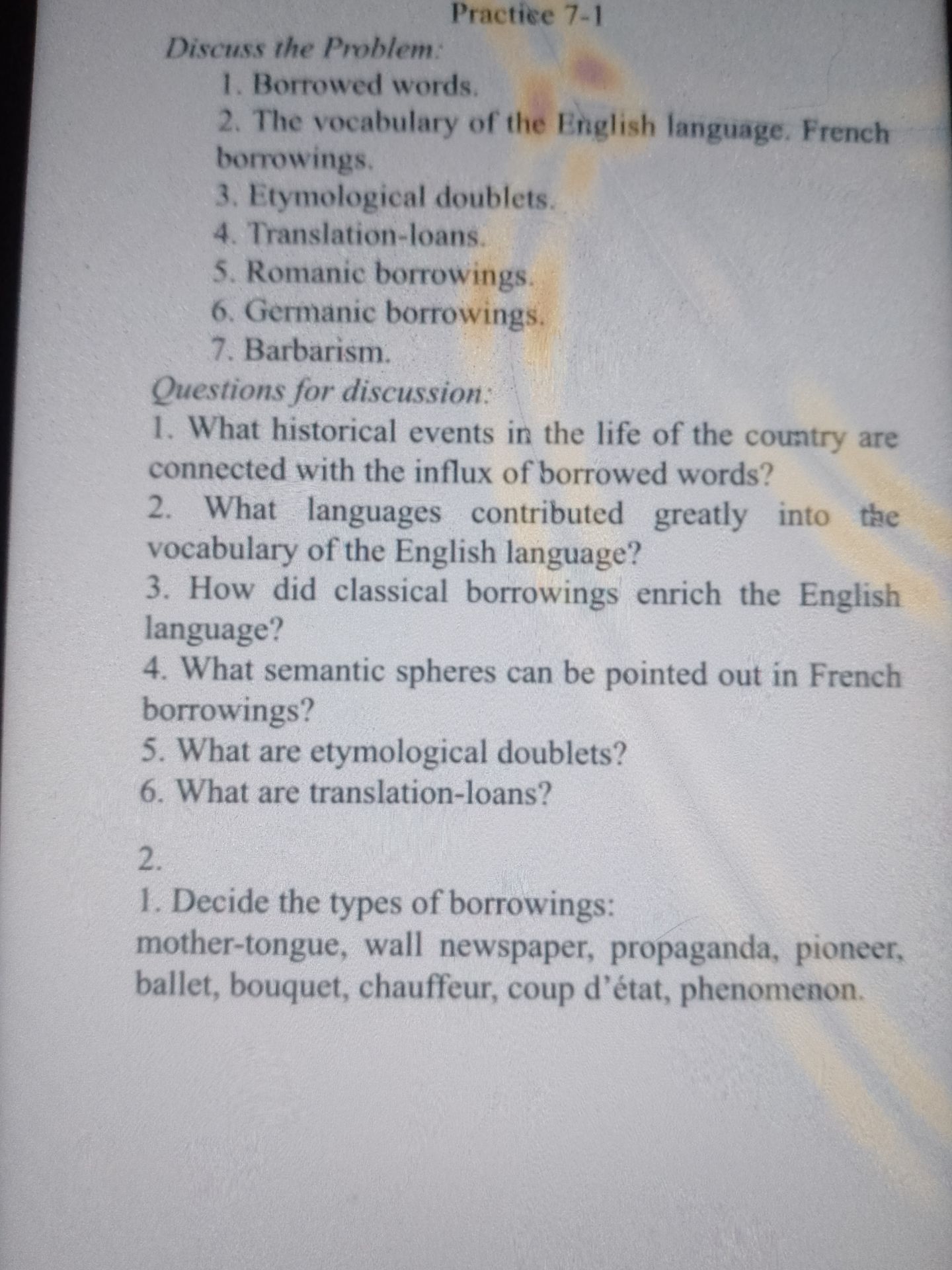
Questions for discussion: 1. What historical events in the life of the country are connected with the influx of borrowed words? 2. What languages contributed greatly into the vocabulary of the English language? 3. How did classical borrowings enrich the English language? 4. What semantic spheres can be pointed out in French borrowings? 5. What are etymological doublets? 6. What are translation-loans?
Ответ:
1. Historical events and borrowed words
Several historical events led to the influx of borrowed words into English:
- The Norman Conquest (1066): This event introduced a vast number of French words into English, especially in areas of government, law, and aristocracy.
- The Renaissance: This period saw a significant influx of words from Latin and Greek, enriching English with scientific, philosophical, and artistic vocabulary.
- The Age of Exploration and Colonialism: English borrowed words from languages all over the world as a result of trade, colonization, and cultural exchange.
- Technological Advancements and Globalization: Modern times have seen rapid borrowing of words related to technology, science, and popular culture from various languages, particularly American English.
2. Major contributing languages
The languages that have contributed most significantly to the English vocabulary are:
- Old English (Germanic): The foundation of the English language.
- Old Norse: Due to Viking invasions and settlement.
- French (Norman and Parisian): Following the Norman Conquest.
- Latin and Greek: Especially during the Renaissance and for scientific/academic terms.
3. Enrichment by classical borrowings
Classical borrowings (from Latin and Greek) enriched the English language by:
- Expanding vocabulary: Providing terms for new concepts in science, philosophy, medicine, and the arts.
- Creating precise terminology: Allowing for more specific and nuanced expression.
- Facilitating international communication: Latin and Greek roots are common across many European languages, aiding scholarly and scientific discourse.
- Adding prestige: Using classical roots often lent an air of sophistication and authority to language.
4. Semantic spheres of French borrowings
French borrowings cover a wide range of semantic spheres:
- Government and Administration: 'government', 'parliament', 'state', 'minister'.
- Law and Justice: 'judge', 'jury', 'evidence', 'crime', 'sentence'.
- Military: 'army', 'navy', 'soldier', 'battle', 'attack'.
- Cuisine: 'beef', 'pork', 'sauce', 'pastry', 'restaurant'.
- Fashion and Art: 'fashion', 'design', 'ballet', 'canvas', 'opera'.
- Society and Social Life: 'society', 'fashion', 'dance', 'conversation'.
5. Etymological doublets
Etymological doublets are pairs of words in the same language that derive from the same ultimate source but have followed different paths of development. Examples include: 'castle' (from Latin 'castellum' via Old French) and 'chastel' (a direct borrowing from Latin); 'pardon' and 'apology' (both from Latin 'parabola'); 'royal' (from Old French 'roial') and 'regal' (from Latin 'regalis').
6. Translation-loans (Calques)
Translation-loans are words or phrases where the components are translated literally from another language. Examples include: 'skyscraper' (from German 'Wolkenkratzer' - cloud-scraper); 'superman' (from German 'Übermensch'); 'beer garden' (from German 'Biergarten'); 'gratitude' (from Latin 'gratitudo', literally 'thankfulness').
Похожие
- Discuss the Problem: 1. Borrowed words. 2. The vocabulary of the English language. French borrowings. 3. Etymological doublets. 4. Translation-loans. 5. Romanic borrowings. 6. Germanic borrowings. 7. Barbarism.
- 2. 1. Decide the types of borrowings: mother-tongue, wall newspaper, propaganda, pioneer, ballet, bouquet, chauffeur, coup d'état, phenomenon.
