
 Алгебра
 Английский
 Биология
 География
 Геометрия
 История
 Русский
 Обществознание
 Физика
 Химия
Химия Информатика
 Литература
 Математика
Вопрос:
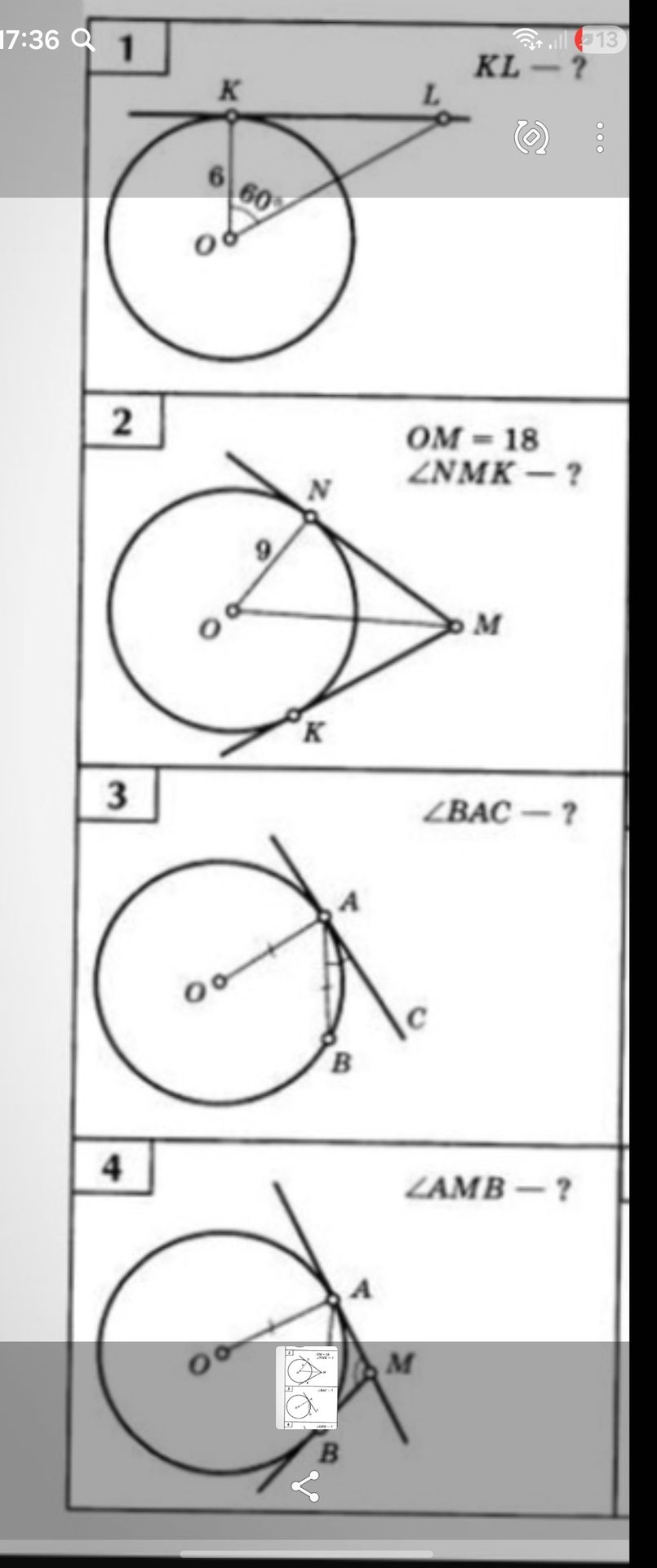
4. Find \(\angle\) AMB.
Ответ:
Solution:
- OA and OB are radii. AM and BM are tangents to the circle from point M.
- Since AM and BM are tangents from M, OM bisects \(\angle AMB\) and \(\angle AOB\). Also, OM is perpendicular to AB if M is on the perpendicular bisector of AB.
- In this diagram, it looks like OA = OB (radii). AM and BM are tangents from M. Therefore, \(\angle OAM = 90^{\circ}\) and \(\angle OBM = 90^{\circ}\).
- In quadrilateral OAMB, the sum of angles is 360 degrees. \(\angle AOB + \angle OAM + \angle AMB + \angle OBM = 360^{\circ}\).
- \(\angle AOB + 90^{\circ} + \angle AMB + 90^{\circ} = 360^{\circ}\)
- \(\angle AOB + \angle AMB = 180^{\circ}\).
- We need to find \(\angle AOB\). From the diagram in problem 3, it was indicated that OA=AB=radius, which made \(\triangle OAB\) equilateral and \(\angle AOB = 60^{\circ}\). If we assume this is a continuation or similar scenario, then \(\angle AOB = 60^{\circ}\).
- If \(\angle AOB = 60^{\circ}\), then \(60^{\circ} + \angle AMB = 180^{\circ}\).
- \(\angle AMB = 180^{\circ} - 60^{\circ} = 120^{\circ}\).
- Let's verify this assumption. The diagram shows OA = radius, and tick marks on AB suggest AB = radius. So \(\triangle OAB\) is equilateral. \(\angle AOB = 60^{\circ}\).
- In \(\triangle OAM\), OA is radius. \(\angle OAM = 90^{\circ}\). \(\angle AOM = \frac{1}{2} \angle AOB = \frac{1}{2} \times 60^{\circ} = 30^{\circ}\).
- In \(\triangle OAM\), \(\tan(\angle AOM) = \frac{AM}{OA}\) => \(\tan(30^{\circ}) = \frac{AM}{OA}\) => \( \frac{1}{\sqrt{3}} = \frac{AM}{OA}\) => \( AM = \frac{OA}{\sqrt{3}} \).
- In \(\triangle OAM\), \(\angle AMO = 180^{\circ} - 90^{\circ} - 30^{\circ} = 60^{\circ}\).
- Since OM bisects \(\angle AMB\), \(\angle AMB = 2 \times \angle AMO = 2 \times 60^{\circ} = 120^{\circ}\).
Answer: \(\angle AMB = 120^{\circ}\).
Похожие
