
 Алгебра
 Английский
 Биология
 География
 Геометрия
 История
 Русский
 Обществознание
 Физика
 Химия
Химия Информатика
 Литература
 Математика
Вопрос:
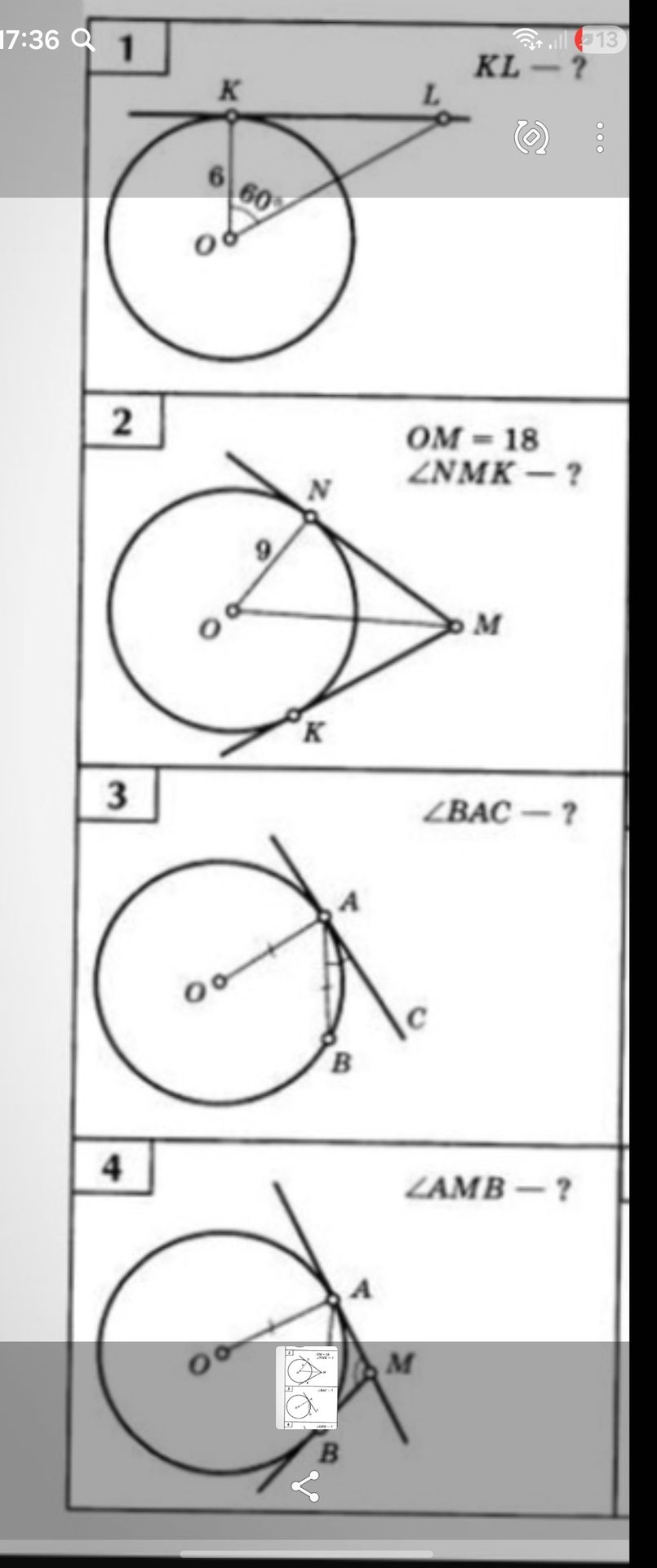
3. Find \(\angle\) BAC.
Ответ:
Solution:
- OA and OB are radii. AB is a chord. AC is a tangent to the circle at point A.
- Since AC is a tangent and OA is the radius to the point of contact, \(\angle OAC = 90^{\circ}\).
- In \(\triangle OAB\), OA = OB (radii), so it is an isosceles triangle.
- Let's assume \(\angle OAB = \angle OBA = x\). Then \(\angle AOB = 180^{\circ} - 2x\).
- We are given that \(\angle BAC\) is to be found. \(\angle BAC = \angle OAC - \angle OAB = 90^{\circ} - x\).
- We need more information to solve this. Let's check the diagram for any implicit information. There are tick marks on OA and AB, which implies OA = AB.
- Since OA = AB, \(\triangle OAB\) is an isosceles triangle with OA = AB. Since OA is a radius, AB is also equal to the radius.
- In \(\triangle OAB\), OA = OB = AB (all are radii). This means \(\triangle OAB\) is an equilateral triangle.
- Therefore, \(\angle AOB = 60^{\circ}\) and \(\angle OAB = \angle OBA = 60^{\circ}\).
- Now, \(\angle BAC = \angle OAC - \angle OAB\).
- Since AC is a tangent at A, \(\angle OAC = 90^{\circ}\).
- So, \(\angle BAC = 90^{\circ} - 60^{\circ} = 30^{\circ}\).
Answer: \(\angle BAC = 30^{\circ}\).
Похожие
