
 Алгебра
 Английский
 Биология
 География
 Геометрия
 История
 Русский
 Обществознание
 Физика
 Химия
Химия Информатика
 Литература
 Математика
Вопрос:
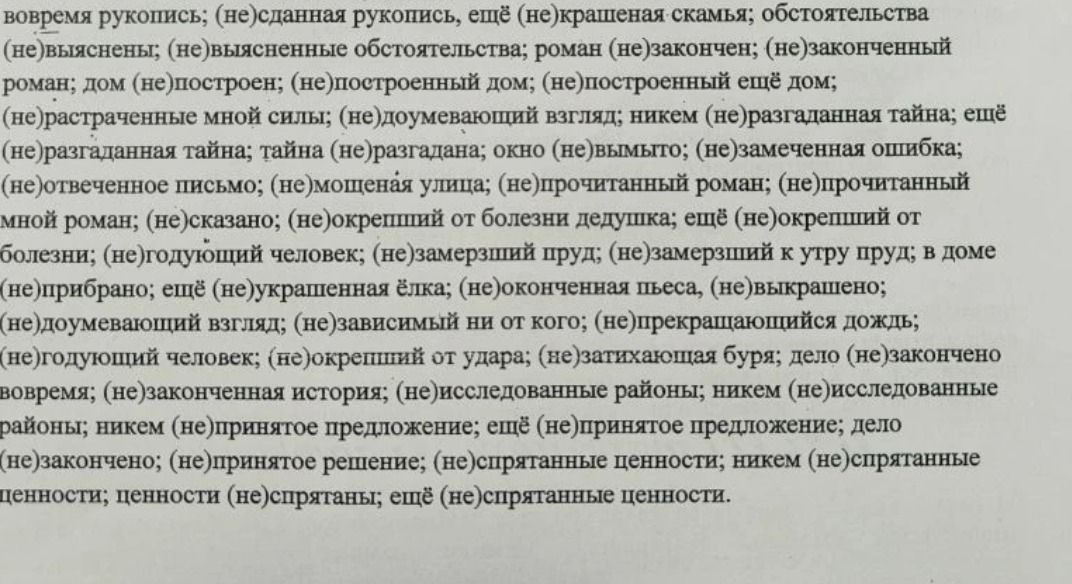
Translate the following Russian phrases into English. For each phrase, identify the part of speech of the key word and explain its grammatical form.
Ответ:
Translation and Grammatical Analysis:
- вовремя рукопись: "in time manuscript" - Here, "рукопись" is a noun in the nominative singular case.
- (не)сданная рукопись: "(not) submitted manuscript" - "рукопись" is a noun in the nominative singular case.
- ещё (не) крашеная скамья: "still (not) painted bench" - "скамья" is a noun in the nominative singular case.
- обстоятельства (не)выяснены: "circumstances (not) clarified" - "обстоятельства" is a noun in the nominative plural case.
- роман (не)закончен: "novel (not) finished" - "роман" is a noun in the nominative singular case.
- дом (не)построен: "house (not) built" - "дом" is a noun in the nominative singular case.
- (не) растраченные мной силы: "(not) wasted by me forces" - "силы" is a noun in the nominative plural case.
- (не) доумевающий взгляд: "(not) puzzled glance" - "взгляд" is a noun in the nominative singular case.
- (не) разгаданная тайна: "(not) unraveled mystery" - "тайна" is a noun in the nominative singular case.
- окно (не)вымыто: "window (not) washed" - "окно" is a noun in the nominative singular case.
- (не)замеченная ошибка: "(not) noticed mistake" - "ошибка" is a noun in the nominative singular case.
- (не) отвеченное письмо: "(not) answered letter" - "письмо" is a noun in the nominative singular case.
- (не) мощеная улица: "(not) paved street" - "улица" is a noun in the nominative singular case.
- (не) прочитанный роман: "(not) read novel" - "роман" is a noun in the nominative singular case.
- (не) окрепший от болезни дедушка: "(not) recovered from illness grandfather" - "дедушка" is a noun in the nominative singular case.
- (не) замерзший пруд: "(not) frozen pond" - "пруд" is a noun in the nominative singular case.
- в доме (не)прибрано: "in the house (not) tidied up" - "доме" is a noun in the prepositional singular case.
- ещё (не) украшенная ёлка: "still (not) decorated Christmas tree" - "ёлка" is a noun in the nominative singular case.
- (не)оконченная пьеса: "(not) finished play" - "пьеса" is a noun in the nominative singular case.
- (не) выкрашено: "(not) painted" - This is a past passive participle used predicatively, functioning as the predicate.
- (не)зависимый ни от кого: "independent of anyone" - "кого" is a pronoun in the genitive singular case.
- (не)прекращающийся дождь: "(not) stopping rain" - "дождь" is a noun in the nominative singular case.
- (не)окрепший от удара: "(not) recovered from the blow" - This phrase acts as an adjective modifying an implied noun, so the structure implies an adjective phrase.
- (не)затихающая буря: "(not) subsiding storm" - "буря" is a noun in the nominative singular case.
- дело (не)закончено: "business (not) finished" - "дело" is a noun in the nominative singular case.
- (не)законченная история: "(not) finished story" - "история" is a noun in the nominative singular case.
- (не) исследованные районы: "(not) explored regions" - "районы" is a noun in the nominative plural case.
- никем (не)принятое предложение: "by no one (not) accepted offer" - "предложение" is a noun in the nominative singular case.
- (не)принятое решение: "(not) accepted decision" - "решение" is a noun in the nominative singular case.
- (не) спрятанные ценности: "(not) hidden values" - "ценности" is a noun in the nominative plural case.
- ценности (не) спрятаны: "values (not) hidden" - "ценности" is a noun in the nominative plural case.
Answer: The phrases describe various states or conditions using nouns, participles, and adjectives, often in their nominative singular or plural forms.
