
 Алгебра
 Английский
 Биология
 География
 Геометрия
 История
 Русский
 Обществознание
 Физика
 Химия
Химия Информатика
 Литература
 Математика
Вопрос:
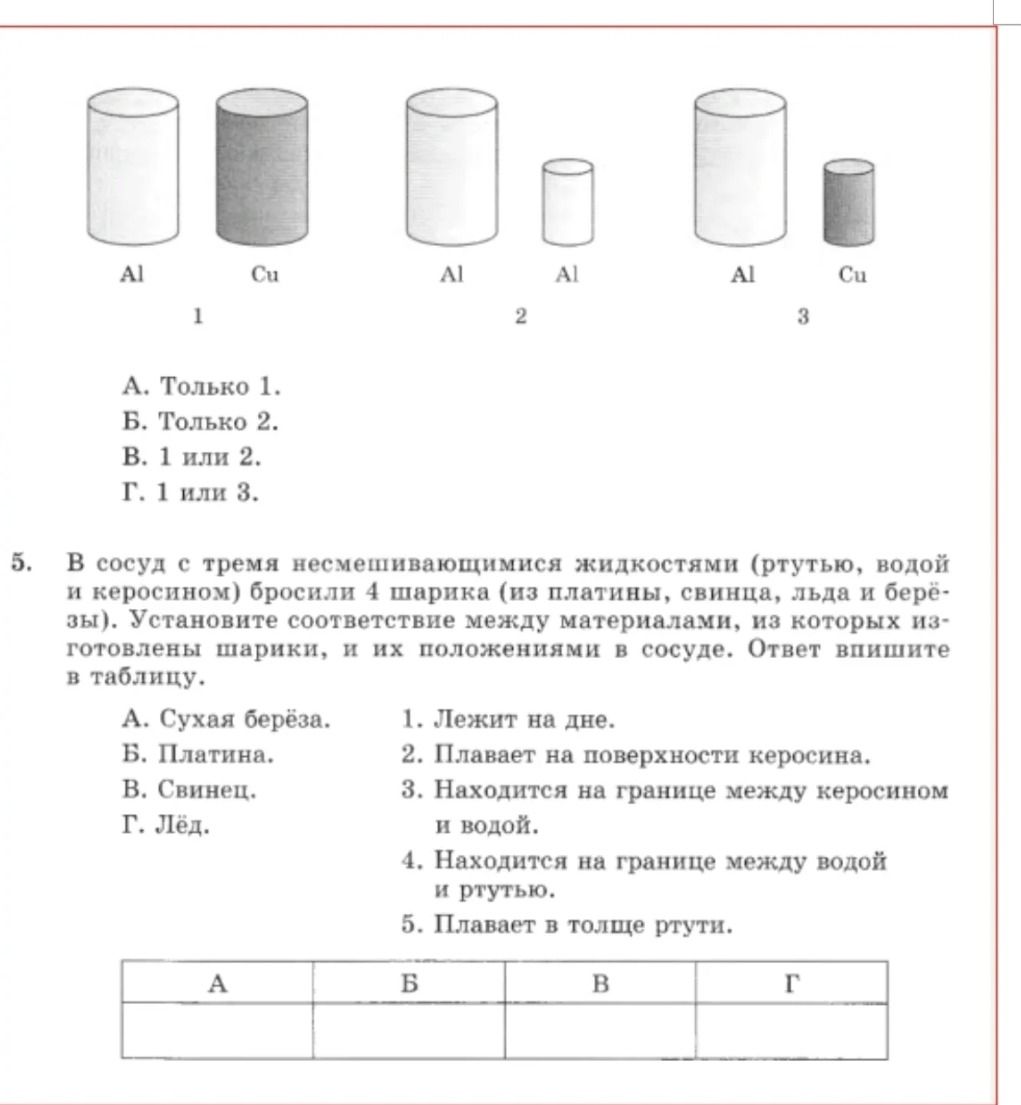
The question consists of an image with a physics problem. The problem describes a scenario where four balls made of different materials (platinum, lead, ice, and birch) are dropped into a container with three immiscible liquids (mercury, water, and kerosene). The task is to match the materials of the balls to their positions in the container and fill in a table. The problem also includes options for the position of a hypothetical fifth ball labeled 'A', 'Б', 'В', 'Г' which appears to be unrelated to the main problem or is a lead-in to the table. Additionally, there are three images labeled 1, 2, and 3 at the top, showing cylinders of different materials and sizes, along with multiple-choice options related to these images (A, Б, В, Г), but the question for these images is not explicitly stated. The primary task is to solve the matching problem described in point 5. Given information: - Three immiscible liquids: mercury (Hg), water (H2O), kerosene. - Densities (approximate, g/cm³): - Mercury (Hg): 13.6 - Platinum (Pt): 21.45 - Lead (Pb): 11.34 - Ice (H2O solid): 0.92 - Birch wood: ~0.6-0.8 - Water (H2O liquid): 1.0 - Kerosene: ~0.8 - Order of liquids from bottom to top based on density: 1. Mercury (densest) 2. Water 3. Kerosene (least dense) - Materials of the balls: A. Birch (dry) Б. Platinum В. Lead Г. Ice - Possible positions/descriptions: 1. Lies at the bottom. 2. Floats on kerosene. 3. Lies between kerosene and water. 4. Lies between water and mercury. 5. Floats in the bulk of mercury. The question is to match the material to its position and fill the table.
Ответ:
Решение:
Для решения задачи необходимо сопоставить плотности материалов шариков с плотностями жидкостей. Жидкости в сосуде располагаются в порядке убывания плотности сверху вниз: керосин (≈ 0,8 г/см³), вода (≈ 1,0 г/см³), ртуть (≈ 13,6 г/см³).
Рассмотрим плотности материалов шариков:
- А. Сухая берёза (плотность ≈ 0,6-0,8 г/см³): Плотность берёзы меньше плотности керосина. Шарик будет плавать на поверхности керосина.
- Б. Платина (плотность ≈ 21,45 г/см³): Плотность платины значительно больше плотности ртути. Шарик будет лежать на дне сосуда (на дне ртути).
- В. Свинец (плотность ≈ 11,34 г/см³): Плотность свинца меньше плотности ртути, но больше плотности воды. Шарик будет плавать в толще ртути, но над водой.
- Г. Лёд (плотность ≈ 0,92 г/см³): Плотность льда меньше плотности воды, но больше плотности керосина. Шарик будет плавать на границе между керосином и водой.
Сопоставим материалы с их положениями:
- А. Сухая берёза — 2. Плавает на поверхности керосина.
- Б. Платина — 1. Лежит на дне.
- В. Свинец — 5. Плавает в толще ртути.
- Г. Лёд — 3. Находится на границе между керосином и водой.
Заполним таблицу:
| A | Б | B | Γ |
|---|---|---|---|
| 2 | 1 | 5 | 3 |
Ответ: в таблице должны быть указаны соответствия: А-2, Б-1, В-5, Г-3.
