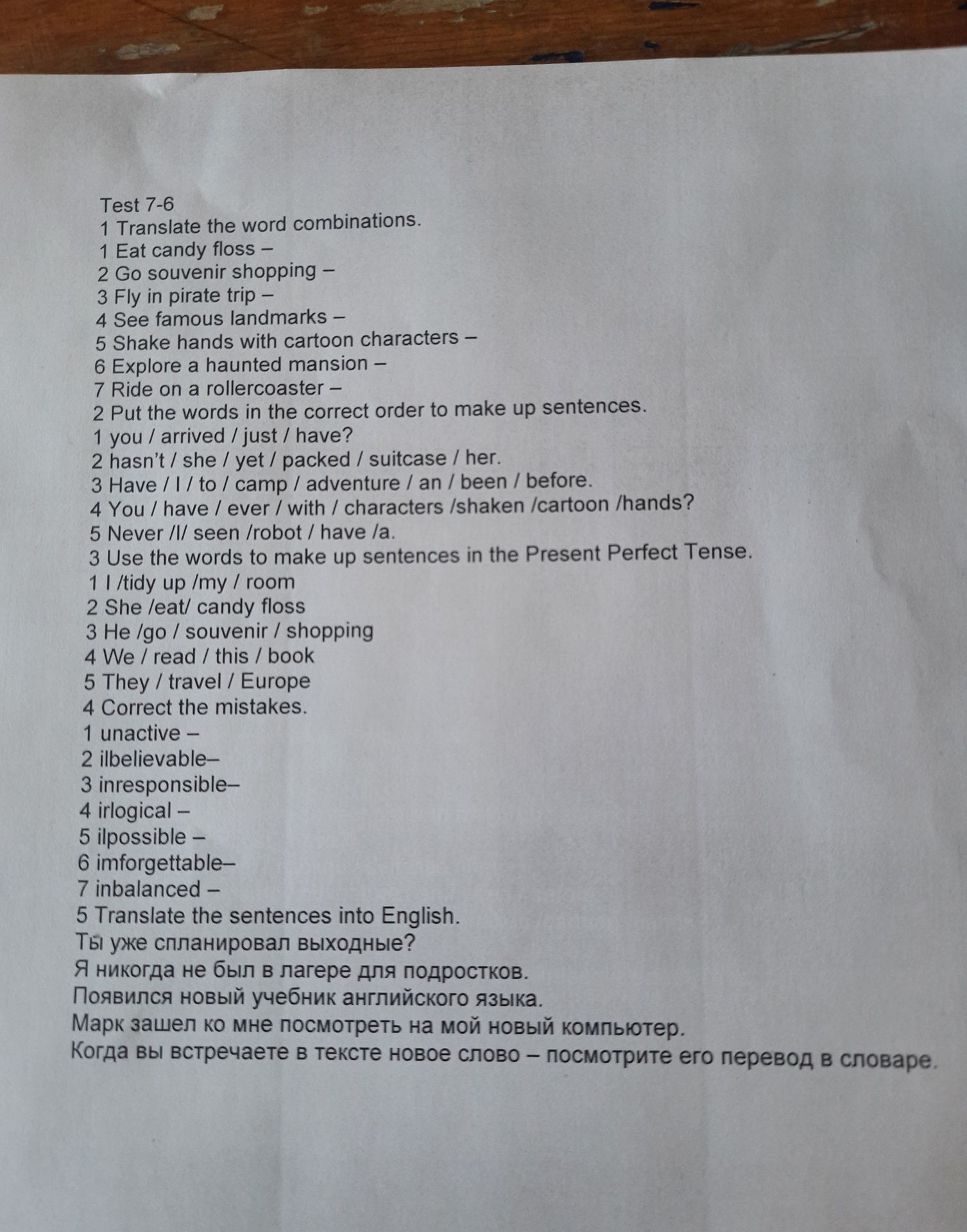
Test 7-6
1 Translate the word combinations.
1 Eat candy floss
2 Go souvenir shopping
3 Fly in pirate trip
4 See famous landmarks
5 Shake hands with cartoon characters
6 Explore a haunted mansion
7 Ride on a rollercoaster
2 Put the words in the correct order to make up sentences.
1 you / arrived / just / have?
2 hasn't / she / yet / packed / suitcase / her.
3 Have /1/ to / camp / adventure / an / been / before.
4 You / have / ever / with / characters/shaken/cartoon/hands?
5 Never /l/ seen /robot / have /a.
3 Use the words to make up sentences in the Present Perfect Tense.
11/tidy up/my/ room
2 She /eat/candy floss
3 He/go / souvenir / shopping
4 We/read / this / book
5 They / travel / Europe
4 Correct the mistakes.
1 unactive
2 ilbelievable-
3 inresponsible-
4 irlogical -
5 ilpossible
6 imforgettable-
7 inbalanced
5 Translate the sentences into English.
Ты уже спланировал выходные?
Я никогда не был в лагере для подростков.
Появился новый учебник английского языка.
Марк зашел ко мне посмотреть на мой новый компьютер.
Когда вы встречаете в тексте новое слово посмотрите его перевод в словаре.
1. Translate the word combinations:
- Eat candy floss — Съесть сладкую вату
- Go souvenir shopping — Купить сувениры
- Fly in pirate trip — Летать в пиратское путешествие
- See famous landmarks — Осмотреть знаменитые достопримечательности
- Shake hands with cartoon characters — Пожать руки с рисованными персонажами
- Explore a haunted mansion — Исследовать дом с привидениями
- Ride on a rollercoaster — Кататься на американских горках
2. Put the words in the correct order to make up sentences:
- Have you just arrived?
- She hasn't packed her suitcase yet.
- Have I been to camp/adventure before?
- Have you ever shaken hands with cartoon characters?
- I have never seen a robot.
3. Use the words to make up sentences in the Present Perfect Tense:
- I have tidied up my room.
- She has eaten candy floss.
- He has gone souvenir shopping.
- We have read this book.
- They have traveled to Europe.
4. Correct the mistakes:
- unactive — inactive
- ilbelievable — unbelievable
- inresponsible — irresponsible
- irlogical — illogical
- ilpossible — impossible
- imforgettable — unforgettable
- inbalanced — unbalanced
5. Translate the sentences into English:
- Have you planned your weekend yet?
- I have never been to a teenagers' camp.
- A new English language textbook has appeared.
- Mark came to my place to look at my new computer.
- When you encounter a new word in the text, look up its translation in a dictionary.

 Алгебра
 Английский
 Биология
 География
 Геометрия
 История
 Русский
 Обществознание
 Физика
 Химия
Химия Информатика
 Литература
 Математика