
 Алгебра
 Английский
 Биология
 География
 Геометрия
 История
 Русский
 Обществознание
 Физика
 Химия
Химия Информатика
 Литература
 Математика
Вопрос:
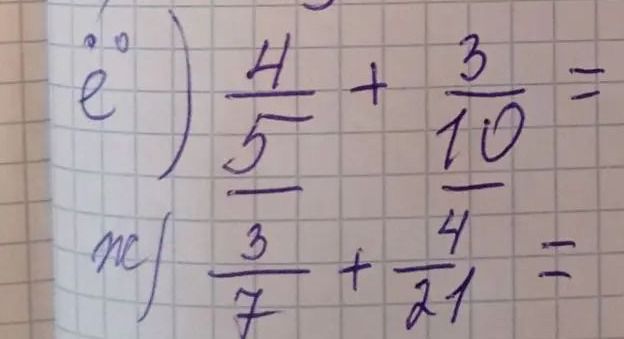
Solve the following addition problems:
Ответ:
Solution:
- \( \frac{4}{5} + \frac{3}{10} \)
- To add these fractions, we need a common denominator. The least common multiple of 5 and 10 is 10.
- Convert \( \frac{4}{5} \) to an equivalent fraction with a denominator of 10: \( \frac{4}{5} \times \frac{2}{2} = \frac{8}{10} \).
- Now add the fractions: \( \frac{8}{10} + \frac{3}{10} = \frac{8+3}{10} = \frac{11}{10} \).
- This can also be written as a mixed number: \( 1 \frac{1}{10} \).
- \( \frac{3}{7} + \frac{4}{21} \)
- The least common multiple of 7 and 21 is 21.
- Convert \( \frac{3}{7} \) to an equivalent fraction with a denominator of 21: \( \frac{3}{7} \times \frac{3}{3} = \frac{9}{21} \).
- Now add the fractions: \( \frac{9}{21} + \frac{4}{21} = \frac{9+4}{21} = \frac{13}{21} \).
Answer: 1. \( \frac{11}{10} \) or \( 1 \frac{1}{10} \); 2. \( \frac{13}{21} \).
