
 Алгебра
 Английский
 Биология
 География
 Геометрия
 История
 Русский
 Обществознание
 Физика
 Химия
Химия Информатика
 Литература
 Математика
Вопрос:
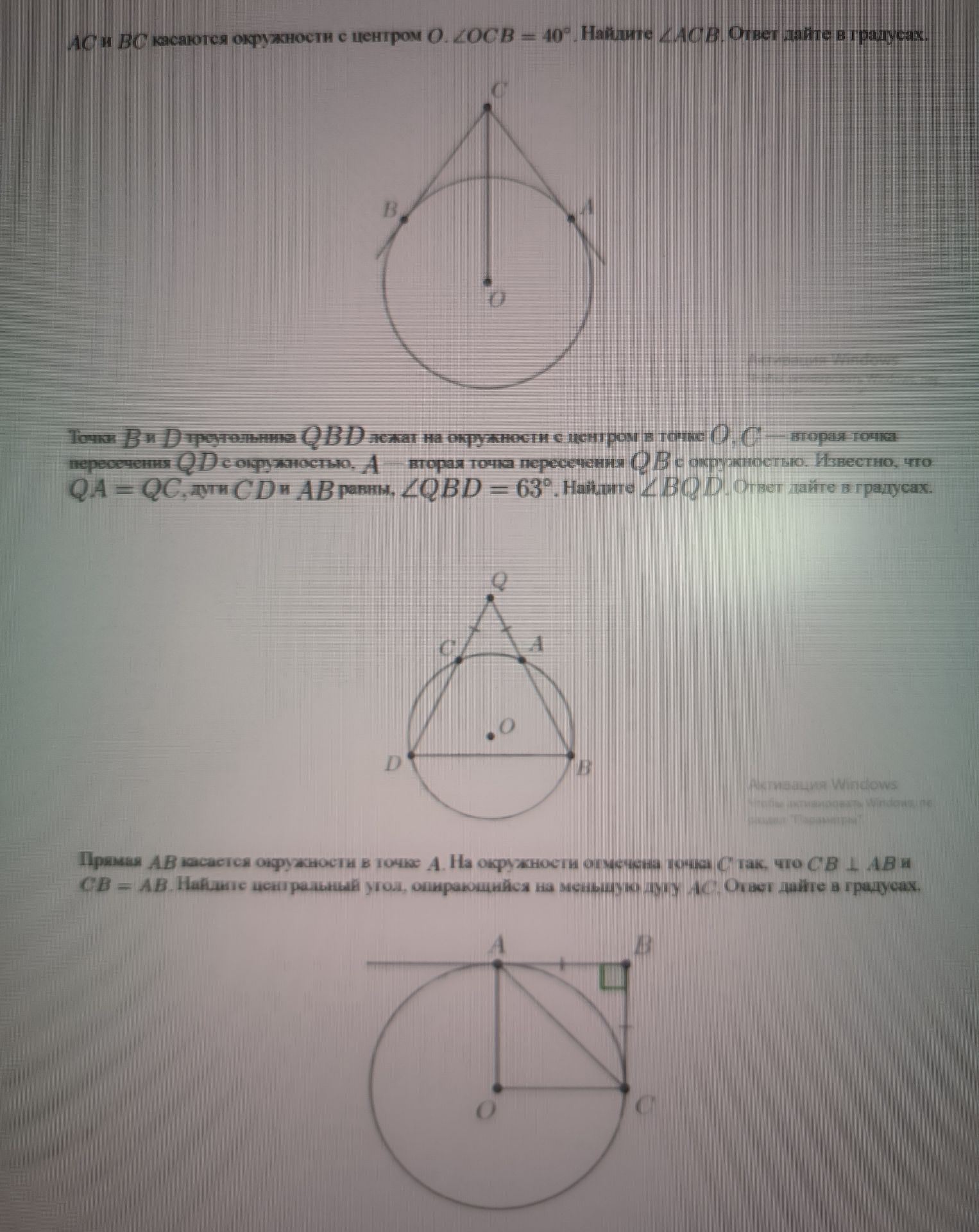
Прямая АВ касается окружности в точке А. На окружности отмечена точка С так, что СВ ⊥ АВ и СВ = АВ. Найдите центральный угол, опирающийся на меньшую дугу АС. Ответ дайте в градусах.
Ответ:
Решение:
- Так как прямая АВ касается окружности в точке А, то радиус ОА перпендикулярен касательной АВ. Следовательно, \( \angle OAB = 90° \).
- По условию СВ ⊥ АВ, значит, \( \angle CBA = 90° \).
- Рассмотрим четырёхугольник ОАВС. Сумма углов четырёхугольника равна 360°. \( \angle AOC + \angle OAB + \angle ABC + \angle BCO = 360° \).
- \( \angle AOC + 90° + 90° + \angle BCO = 360° \)
- \( \angle AOC + \angle BCO = 180° \).
- По условию СВ = АВ.
- В треугольнике ОАВ, ОА — радиус.
- В треугольнике СВВ, СВ = АВ.
- Рассмотрим треугольник ОАВ. \( \angle OAB = 90° \).
- Рассмотрим треугольник СВА. \( \angle CBA = 90° \).
- В треугольнике ОАВ, по теореме Пифагора, \( OB^2 = OA^2 + AB^2 \). Так как ОА — радиус (обозначим его r), то \( OB^2 = r^2 + AB^2 \).
- \( OB = \sqrt{r^2 + AB^2} \).
- В треугольнике СВА, \( CA^2 = CB^2 + AB^2 \). Так как СВ = АВ, то \( CA^2 = AB^2 + AB^2 = 2AB^2 \). \( CA = AB \sqrt{2} \).
- Так как СВ = АВ, то \( CA^2 = 2 CB^2 \).
- В треугольнике ОВС, ОВ — гипотенуза. \( OB^2 = OC^2 + CB^2 \). OC — радиус, значит OC = r.
- \( OB^2 = r^2 + CB^2 \).
- Из \( OB^2 = r^2 + AB^2 \) и \( OB^2 = r^2 + CB^2 \), следует, что \( AB^2 = CB^2 \), что соответствует условию АВ = СВ.
- Теперь найдём угол \( \angle BOC \). В прямоугольном треугольнике ОВС, \( \tan(\angle BOC) = \frac{CB}{OC} = \frac{AB}{r} \).
- В прямоугольном треугольнике ОАВ, \( \tan(\angle AOB) = \frac{AB}{OA} = \frac{AB}{r} \).
- Значит, \( \angle BOC = \angle AOB \).
- Рассмотрим треугольник ОАВ. \( \angle OAB = 90° \). \( OA = r \). \( AB \).
- Рассмотрим треугольник ОВС. \( \angle OBC = 90° \) — НЕ ВЕРНО. \( \angle CBA = 90° \). \( OB \) — гипотенуза. \( OC = r \). \( CB = AB \).
- Так как \( \angle OAB = 90° \) и \( \angle CBA = 90° \), то quadrilateral OABC is a trapezoid with parallel sides OA and CB if OB is a transversal. However, OB is not necessarily perpendicular to OA and CB.
- Consider \( \triangle OAB \) and \( \triangle OCB \). \( OA = OC = r \). \( AB = CB \). \( OB \) is common. Thus, \( \triangle OAB \) is congruent to \( \triangle OCB \) by SSS.
- Therefore, \( \angle OAB = \angle OCB = 90° \) — this contradicts the given \( \angle OAB = 90° \) and \( \angle CBA = 90° \). Something is wrong with the congruence assumption.
- Let's restart. \( \angle OAB = 90° \). \( \angle CBA = 90° \). \( AB = CB \).
- In \( \triangle OAB \), \( OB^2 = OA^2 + AB^2 = r^2 + AB^2 \).
- In \( \triangle OCB \), \( OB^2 = OC^2 + CB^2 = r^2 + AB^2 \) (since OC=r and CB=AB). This is consistent.
- In \( \triangle OAB \), let \( \angle AOB = \alpha \). Then \( \tan(\alpha) = \frac{AB}{OA} = \frac{AB}{r} \).
- In \( \triangle OCB \), let \( \angle COB = \beta \). Then \( \tan(\beta) = \frac{CB}{OC} = \frac{AB}{r} \).
- Thus, \( \angle AOB = \angle COB = \alpha \).
- The central angle \( \angle AOC \) is the angle we need to find. \( \angle AOC = \angle AOB + \angle BOC = \alpha + \alpha = 2\alpha \).
- In \( \triangle OAB \), \( \angle OBA = 90° - \alpha \).
- In \( \triangle OCB \), \( \angle OCB = 90° - \beta = 90° - \alpha \).
- The sum of angles in \( \triangle OCB \) is \( \angle BOC + \angle OCB + \angle CBO = 180° \).
- \( \alpha + (90° - \alpha) + \angle CBO = 180° \).
- \( 90° + \angle CBO = 180° \). \( \angle CBO = 90° \).
- This means that \( \angle ABC = \angle ABO + \angle CBO = (90° - \alpha) + 90° = 180° - \alpha \).
- But we are given \( \angle ABC = 90° \). So, \( 180° - \alpha = 90° \) which implies \( \alpha = 90° \).
- If \( \alpha = 90° \), then \( \angle AOB = 90° \). And \( \angle BOC = 90° \). Then \( \angle AOC = 180° \). This would mean A, O, C are collinear, which is not possible from the diagram.
- Let's re-evaluate the statement \( \angle OCB = 90° - \alpha \). This assumes \( \triangle OCB \) is a right-angled triangle at O, which is not given.
- We have \( \angle OAB = 90° \) and \( \angle CBA = 90° \). This means that OA is parallel to CB. And AB is a transversal.
- This forms a right trapezoid OABC.
- Since OA = OC = r (radii), this is an isosceles trapezoid. In an isosceles trapezoid, the non-parallel sides are equal, so AB = OC = r.
- Also, the base angles are equal. \( \angle OAB = \angle OCB = 90° \) and \( \angle ABC = \angle BAC \). This is incorrect.
- In an isosceles trapezoid with parallel sides OA and CB, we have \( AB = OC \). Since OC = r, then AB = r.
- Given AB = CB, we have CB = r.
- Now consider \( \triangle OCB \). OC = r, CB = r. So \( \triangle OCB \) is an isosceles triangle.
- Since \( \angle CBA = 90° \), \( OB \) is the hypotenuse of \( \triangle OCB \).
- In \( \triangle OCB \), OC = r, CB = r. \( OB^2 = OC^2 + CB^2 = r^2 + r^2 = 2r^2 \). \( OB = r \sqrt{2} \).
- Also, \( \triangle OAB \) is a right-angled triangle at A. OA = r. AB = r. So \( \triangle OAB \) is an isosceles right-angled triangle.
- Therefore, \( \angle AOB = 45° \).
- In \( \triangle OCB \), OC = r, CB = r. It is an isosceles triangle. What about \( \angle BOC \)?
- We know \( \angle CBA = 90° \). This is the angle formed by the line segment CB and AB.
- Consider \( \triangle OCB \). OC = r, CB = r. \( OB = r \sqrt{2} \).
- By the Law of Cosines in \( \triangle OCB \): \( OB^2 = OC^2 + CB^2 - 2 @ OC @ CB @ @ @ @ @ @ \cos(\angle BOC) \).
- \( (r\sqrt{2})^2 = r^2 + r^2 - 2 @ r @ r @ @ @ @ @ \cos(\angle BOC) \).
- \( 2r^2 = 2r^2 - 2r^2 @ @ @ @ \cos(\angle BOC) \).
- \( 0 = -2r^2 @ @ @ @ \cos(\angle BOC) \). This implies \( \cos(\angle BOC) = 0 \), so \( \angle BOC = 90° \).
- So, we have \( \angle AOB = 45° \) and \( \angle BOC = 90° \).
- The central angle subtending arc AC is \( \angle AOC = \angle AOB + \angle BOC = 45° + 90° = 135° \).
- Let's verify if \( \angle CBA = 90° \) is satisfied.
- In \( \triangle OAB \), OA=r, AB=r, \( \angle OAB = 90° \). So \( \angle OBA = 45° \).
- In \( \triangle OCB \), OC=r, CB=r, \( \angle BOC = 90° \). So \( \triangle OCB \) is an isosceles right triangle. \( \angle OCB = \angle OBC = 45° \).
- Then \( \angle CBA = \angle OBA + \angle OBC = 45° + 45° = 90° \). This matches the condition.
- The central angle subtending the minor arc AC is \( \angle AOC = \angle AOB + \angle BOC = 45° + 90° = 135° \).
Ответ: 135°.
Похожие
- АС и ВС касаются окружности с центром О. ∠OCB = 40°. Найдите ∠ACB. Ответ дайте в градусах.
- Точки В и D треугольника QBD лежат на окружности с центром в точке О. С — вторая точка пересечения QD с окружностью. А — вторая точка пересечения QB с окружностью. Известно, что QA = QC, дуги CD и AB равны, ∠QBD = 63°. Найдите ∠BQD. Ответ дайте в градусах.
