
 Алгебра
 Английский
 Биология
 География
 Геометрия
 История
 Русский
 Обществознание
 Физика
 Химия
Химия Информатика
 Литература
 Математика
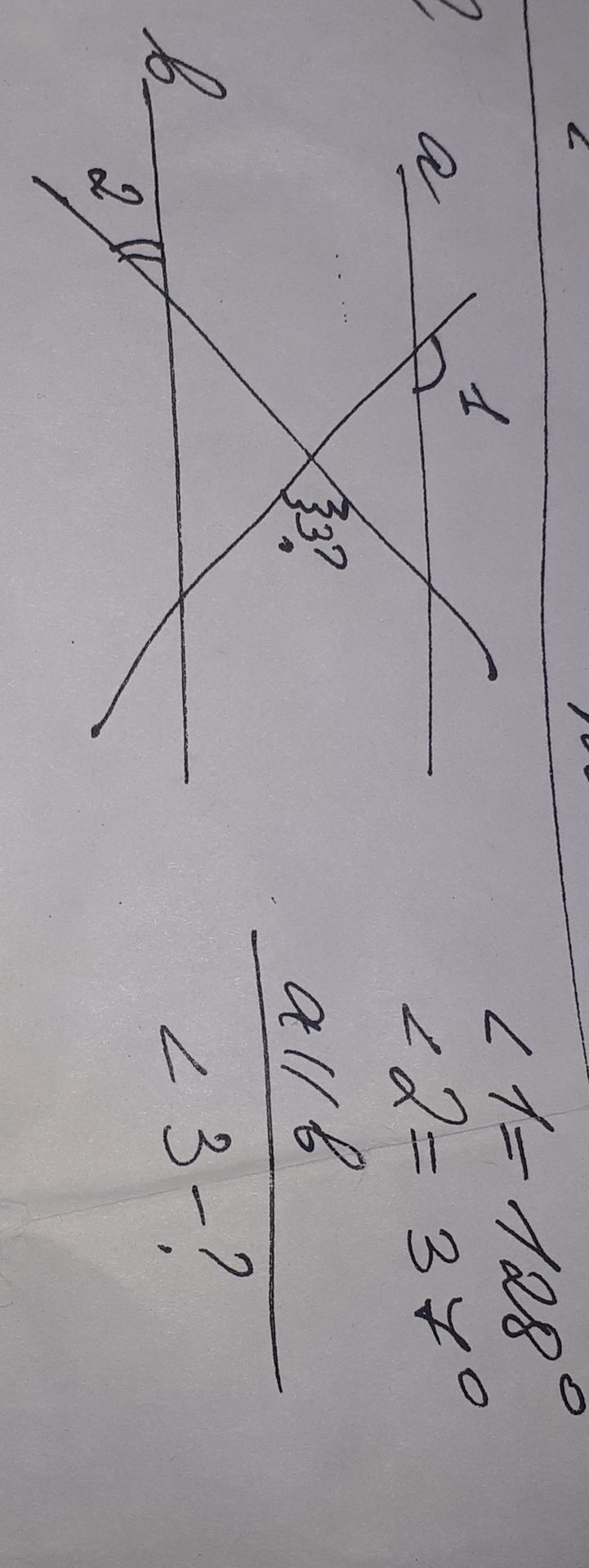
In the given diagram, lines a and b are parallel. Angle 1 is 128 degrees and angle 2 is 37 degrees. Find the measure of angle 3.
Ответ:
Solution:
The problem provides a diagram with two parallel lines, \( a \) and \( b \), intersected by transversals. We are given the measures of two angles, \( \angle 1 = 128^{\circ} \) and \( \angle 2 = 37^{\circ} \), and we need to find the measure of \( \angle 3 \).
First, let's find the measure of the angle adjacent to \( \angle 1 \) on the straight line. Let's call this angle \( \angle 4 \).
\( \angle 1 + \angle 4 = 180^{\circ} \) (linear pair)
\( 128^{\circ} + \angle 4 = 180^{\circ} \)
\( \angle 4 = 180^{\circ} - 128^{\circ} \)
\( \angle 4 = 52^{\circ} \)
Since lines \( a \) and \( b \) are parallel, \( \angle 4 \) and the angle vertically opposite to \( \angle 2 \) are alternate interior angles. However, this doesn't directly help us find \( \angle 3 \) yet. Let's use another approach.
Let's consider the angle that is vertically opposite to \( \angle 2 \). Let's call this angle \( \angle 5 \).
\( \angle 5 = \angle 2 = 37^{\circ} \) (vertically opposite angles).
Now consider the triangle formed by the intersection of the two transversals and the parallel line \( b \). The angles of this triangle are \( \angle 4 \), \( \angle 5 \), and an unknown angle that is part of \( \angle 3 \).
Alternatively, let's extend the transversal that forms \( \angle 3 \) to intersect line \( a \). Let's call the intersection point \( P \) on line \( a \) and \( Q \) on line \( b \). Let the third vertex of the triangle be \( R \).
The angle \( \angle 1 \) is given as \( 128^{\circ} \). The angle adjacent to it on the straight line \( a \) is \( 180^{\circ} - 128^{\circ} = 52^{\circ} \). Let's call this angle \( \alpha \).
The angle \( \angle 2 \) is given as \( 37^{\circ} \). The angle vertically opposite to it is also \( 37^{\circ} \).
Let's draw a line parallel to \( a \) and \( b \) passing through the vertex of \( \angle 3 \). Let this line be \( c \).
The angle \( 128^{\circ} \) and the interior angle on the same side of the transversal are supplementary. So, the angle inside the triangle on line \( a \) is \( 180^{\circ} - 128^{\circ} = 52^{\circ} \).
The angle \( 37^{\circ} \) is given. The angle vertically opposite to it is \( 37^{\circ} \).
Let's find the third angle in the triangle formed by the transversals. One angle is \( 52^{\circ} \). The other angle is \( 37^{\circ} \) (vertically opposite to the given \( 37^{\circ} \)).
The sum of angles in a triangle is \( 180^{\circ} \).
Let the third angle in the triangle be \( \beta \).
\( 52^{\circ} + 37^{\circ} + \beta = 180^{\circ} \)
\( 89^{\circ} + \beta = 180^{\circ} \)
\( \beta = 180^{\circ} - 89^{\circ} \)
\( \beta = 91^{\circ} \)
The angle \( \angle 3 \) is formed by the transversal intersecting line \( b \). The angle \( \beta \) we found is an interior angle of the triangle. The angle \( \angle 3 \) is the exterior angle to this triangle, or it is related to the interior angles.
Let's re-examine the diagram and labels.
Given: \( \angle 1 = 128^{\circ} \). The angle adjacent to \( \angle 1 \) on line \( a \) is \( 180^{\circ} - 128^{\circ} = 52^{\circ} \). Let's call this \( \alpha \).
Given: \( \angle 2 = 37^{\circ} \). The angle vertically opposite to \( \angle 2 \) is \( 37^{\circ} \). Let's call this \( \gamma \).
Consider the triangle formed by the intersection of the two transversals and the line \( b \). The angles inside this triangle are:
- The angle \( \alpha = 52^{\circ} \) (alternate interior angle to the angle adjacent to \( \angle 1 \) on line \( a \)).
- The angle \( \gamma = 37^{\circ} \) (vertically opposite to \( \angle 2 \)).
- Let the third angle of the triangle be \( \delta \).
The sum of angles in a triangle is \( 180^{\circ} \).
\( \alpha + \gamma + \delta = 180^{\circ} \)
\( 52^{\circ} + 37^{\circ} + \delta = 180^{\circ} \)
\( 89^{\circ} + \delta = 180^{\circ} \)
\( \delta = 180^{\circ} - 89^{\circ} \)
\( \delta = 91^{\circ} \)
Now, \( \angle 3 \) is an exterior angle to this triangle, or it is related to \( \delta \).
Looking at the diagram, \( \angle 3 \) and \( \delta \) form a linear pair along line \( b \) IF the transversal forming \( \angle 3 \) intersects line \( b \) at the same point where the other transversal intersects line \( b \) and forms the angle \( \delta \) as an interior angle of the triangle.
However, \( \angle 3 \) is shown outside the triangle. Let's assume \( \angle 3 \) is the angle adjacent to \( \delta \) on the straight line formed by the transversal. Then:
\( \angle 3 + \delta = 180^{\circ} \) (linear pair)
\( \angle 3 + 91^{\circ} = 180^{\circ} \)
\( \angle 3 = 180^{\circ} - 91^{\circ} \)
\( \angle 3 = 89^{\circ} \)
Let's verify this by considering the other transversal intersecting line \( b \).
The angle \( \angle 1 = 128^{\circ} \). The corresponding angle on line \( b \) would be equal to \( 128^{\circ} \). The angle \( \angle 3 \) is adjacent to this angle on the straight line formed by the transversal.
Let's denote the angle supplementary to \( \angle 1 \) as \( \angle 1' = 180^{\circ} - 128^{\circ} = 52^{\circ} \). This \( \angle 1' \) is an interior angle on the same side of the transversal as \( \angle 3 \) if we consider the transversal as intersecting parallel lines \( a \) and \( b \) and \( \angle 3 \) is the angle formed by line \( b \) and the transversal. But \( \angle 3 \) is not directly related this way.
Let's reconsider the triangle approach. \( \angle 4 = 52^{\circ} \) (alternate interior to the angle adjacent to \( \angle 1 \)). \( \angle 5 = 37^{\circ} \) (vertically opposite to \( \angle 2 \)). The third angle in the triangle is \( \delta = 91^{\circ} \).
The angle \( \angle 3 \) is shown as an exterior angle to the triangle, on the line \( b \). If \( \delta \) is the interior angle, then \( \angle 3 \) is supplementary to \( \delta \) if it were on the same straight line. However, the diagram suggests \( \angle 3 \) is the angle formed by line \( b \) and the transversal. In this case, \( \angle 3 \) and \( \delta \) are not supplementary in a simple linear pair fashion.
Let's draw a line through the vertex of \( \angle 3 \) parallel to \( a \) and \( b \). Let's call this line \( c \).
The angle \( 128^{\circ} \) is given. The angle adjacent to it is \( 52^{\circ} \). This \( 52^{\circ} \) angle is alternate interior to an angle formed by the transversal and line \( b \). Let's call the intersection of the transversals point \( O \). The angle at \( O \) within the triangle is \( 91^{\circ} \).
Let's use the property of the sum of angles of a triangle. We have identified two angles of the triangle as \( 52^{\circ} \) and \( 37^{\circ} \). The third angle of the triangle is \( 180^{\circ} - 52^{\circ} - 37^{\circ} = 91^{\circ} \).
The angle \( \angle 3 \) is shown as the angle formed by the line \( b \) and the transversal. The angle \( 91^{\circ} \) is the interior angle of the triangle. The angle \( \angle 3 \) is adjacent to the angle that forms the linear pair with the \( 91^{\circ} \) angle on the line \( b \). This means \( \angle 3 \) and the \( 91^{\circ} \) angle are supplementary.
\( \angle 3 + 91^{\circ} = 180^{\circ} \)
\( \angle 3 = 180^{\circ} - 91^{\circ} \)
\( \angle 3 = 89^{\circ} \)
Let's re-evaluate the interpretation of the diagram. The angle labeled \( 33^{\circ} \) seems to be part of the angle \( \angle 3 \). This changes the problem significantly.
Let's assume the angle \( 33^{\circ} \) is indeed part of \( \angle 3 \).
We have \( \angle 1 = 128^{\circ} \) and \( \angle 2 = 37^{\circ} \).
The angle adjacent to \( \angle 1 \) is \( 180^{\circ} - 128^{\circ} = 52^{\circ} \).
The angle vertically opposite to \( \angle 2 \) is \( 37^{\circ} \).
Consider the triangle formed by the intersection of the two transversals and line \( b \).
One angle of the triangle is \( 52^{\circ} \) (alternate interior to the angle adjacent to \( \angle 1 \)).
Another angle of the triangle is \( 37^{\circ} \) (vertically opposite to \( \angle 2 \)).
The third angle of the triangle is \( 180^{\circ} - 52^{\circ} - 37^{\circ} = 91^{\circ} \). Let's call this \( \angle O \).
Now, if \( \angle 3 \) is comprised of \( 33^{\circ} \) and another angle, let's call that other angle \( \angle x \).
The angle \( \angle 3 \) is on line \( b \). It appears to be an exterior angle in relation to the triangle, or it's an angle formed by line \( b \) and the transversal.
Let's assume the \( 33^{\circ} \) is an angle and \( \angle 3 \) is a different angle. The problem states "angle 3 - ?".
Let's assume the diagram implies the angle \( 33^{\circ} \) is the angle we need to find, i.e., \( \angle 3 = 33^{\circ} \) and it's asking to verify or use it.
However, the question asks to FIND \( \angle 3 \).
Let's interpret the \( 33^{\circ} \) as a given angle and \( \angle 3 \) as another angle to be found. This is confusing.
Let's assume the diagram is drawn such that there is an angle marked \( 33^{\circ} \) and we are asked to find \( \angle 3 \) which is labeled separately.
Let's ignore the \( 33^{\circ} \) for a moment and proceed with the initial calculation.
We found the interior angles of the triangle formed by the intersection of transversals to be \( 52^{\circ} \) and \( 37^{\circ} \) and \( 91^{\circ} \).
The angle \( \angle 3 \) is an angle on the line \( b \). If we assume \( \angle 3 \) is the angle adjacent to the \( 91^{\circ} \) angle on the straight line \( b \), then \( \angle 3 = 180^{\circ} - 91^{\circ} = 89^{\circ} \).
Let's assume the \( 33^{\circ} \) is part of \( \angle 3 \). This would mean \( \angle 3 = 33^{\circ} + \text{some other angle} \).
Let's assume the label \( 33^{\circ} \) is incorrect or irrelevant and focus on finding \( \angle 3 \) based on \( \angle 1 \) and \( \angle 2 \).
Given \( \angle 1 = 128^{\circ} \). The interior angle on the same side of the transversal is \( 180^{\circ} - 128^{\circ} = 52^{\circ} \). Let's call this \( \alpha \).
Given \( \angle 2 = 37^{\circ} \). The alternate interior angle is \( 37^{\circ} \). Let's call this \( \beta \).
Now, consider the triangle formed by the transversals and line \( b \). The angles are \( \alpha \), \( \beta \), and the angle at the intersection of the transversals.
No, this is incorrect. \( \alpha \) and \( \beta \) are not angles of the same triangle in this configuration.
Let's use the property of the sum of angles in a triangle formed by the intersection of the two transversals and the line \( b \).
Angle 1: \( 128^{\circ} \). Angle adjacent to it on line \( a \) is \( 180^{\circ} - 128^{\circ} = 52^{\circ} \). This angle is alternate interior to an angle in the triangle. Let's call this angle \( \alpha = 52^{\circ} \).
Angle 2: \( 37^{\circ} \). The vertically opposite angle is \( 37^{\circ} \). This angle is also part of the triangle. Let's call this angle \( \beta = 37^{\circ} \).
The third angle in the triangle is \( \gamma = 180^{\circ} - (52^{\circ} + 37^{\circ}) = 180^{\circ} - 89^{\circ} = 91^{\circ} \).
Now, consider the line \( b \) and the transversal that forms \( \angle 3 \). The angle \( \angle 3 \) and the angle \( \gamma = 91^{\circ} \) are adjacent angles on the straight line \( b \) formed by the transversal. Therefore, they are supplementary.
\( \angle 3 + \gamma = 180^{\circ} \)
\( \angle 3 + 91^{\circ} = 180^{\circ} \)
\( \angle 3 = 180^{\circ} - 91^{\circ} \)
\( \angle 3 = 89^{\circ} \)
The presence of \( 33^{\circ} \) in the diagram is confusing. It might be a separate problem or an intended part of \( \angle 3 \). However, based on the clear labels for \( \angle 1 \) and \( \angle 2 \), and the request to find \( \angle 3 \), the calculation leading to \( 89^{\circ} \) seems correct if \( 33^{\circ} \) is ignored.
Let's consider if \( 33^{\circ} \) is meant to be \( \angle 2 \), which would mean \( \angle 2 = 33^{\circ} \) instead of \( 37^{\circ} \).
If \( \angle 2 = 33^{\circ} \):
\( \alpha = 52^{\circ} \)
\( \beta = 33^{\circ} \) (vertically opposite to \( \angle 2 \))
\( \gamma = 180^{\circ} - (52^{\circ} + 33^{\circ}) = 180^{\circ} - 85^{\circ} = 95^{\circ} \)
\( \angle 3 = 180^{\circ} - 95^{\circ} = 85^{\circ} \).
This does not match the \( 33^{\circ} \) label's placement.
Let's assume \( 33^{\circ} \) is a part of \( \angle 3 \). Let \( \angle 3 = x + 33^{\circ} \).
The angle \( 91^{\circ} \) is the interior angle of the triangle at the intersection of the transversals.
If \( \angle 3 \) is the angle adjacent to the interior angle of the triangle on line \( b \), then \( \angle 3 = 180^{\circ} - 91^{\circ} = 89^{\circ} \). In this case, the \( 33^{\circ} \) label is confusing.
Let's assume the question is asking for the measure of the angle marked \( 33^{\circ} \) and is labelling it as \( \angle 3 \).
If \( \angle 3 \) refers to the angle marked \( 33^{\circ} \), then the answer is simply \( 33^{\circ} \).
However, the text below the diagram reads: \( \angle 1 = 128^{\circ} \), \( \angle 2 = 37^{\circ} \), \( \angle 3 - ? \).
This implies we need to calculate \( \angle 3 \) using \( \angle 1 \) and \( \angle 2 \).
Let's go back to the first calculation where \( \angle 3 \) is supplementary to the third angle of the triangle.
\( \alpha = 52^{\circ} \) (alternate interior to angle adjacent to \( \angle 1 \))
\( \beta = 37^{\circ} \) (vertically opposite to \( \angle 2 \))
\( \gamma = 180^{\circ} - (52^{\circ} + 37^{\circ}) = 91^{\circ} \) (third angle of the triangle)
\( \angle 3 \) is supplementary to \( \gamma \) because they form a linear pair on line \( b \).
\( \angle 3 = 180^{\circ} - 91^{\circ} = 89^{\circ} \).
The \( 33^{\circ} \) is likely a distraction or an error in the diagram.
Let's consider another interpretation: \( \angle 3 \) is not the angle adjacent to \( \gamma \) on the line \( b \) but is the angle formed by the transversal and line \( b \) such that it is the alternate interior angle to \( \gamma \). This would mean \( \angle 3 = \gamma = 91^{\circ} \).
However, the diagram shows \( \angle 3 \) and the angle marked \( 33^{\circ} \) next to it as if they are parts of a larger angle or adjacent angles.
Let's assume that the question is asking for the angle marked \( 33^{\circ} \) and it is labeled as \( \angle 3 \). In this case, the answer would be \( 33^{\circ} \).
But the text says \( \angle 3 - ? \), implying it needs to be calculated.
Let's consider the case where \( \angle 3 \) is the angle formed by the transversal and line \( b \), and the angle \( 33^{\circ} \) is a different angle.
If we assume \( \angle 3 \) refers to the angle whose value is to be determined, and the \( 33^{\circ} \) is another angle present in the diagram. Given the text \( \angle 3 - ? \), we should calculate \( \angle 3 \).
Let's assume \( \angle 3 \) is the exterior angle to the triangle at the vertex on line \( b \). In that case, \( \angle 3 = \alpha + \beta = 52^{\circ} + 37^{\circ} = 89^{\circ} \).
This interpretation fits the visual representation of \( \angle 3 \) as being
