
 Алгебра
 Английский
 Биология
 География
 Геометрия
 История
 Русский
 Обществознание
 Физика
 Химия
Химия Информатика
 Литература
 Математика
Вопрос:
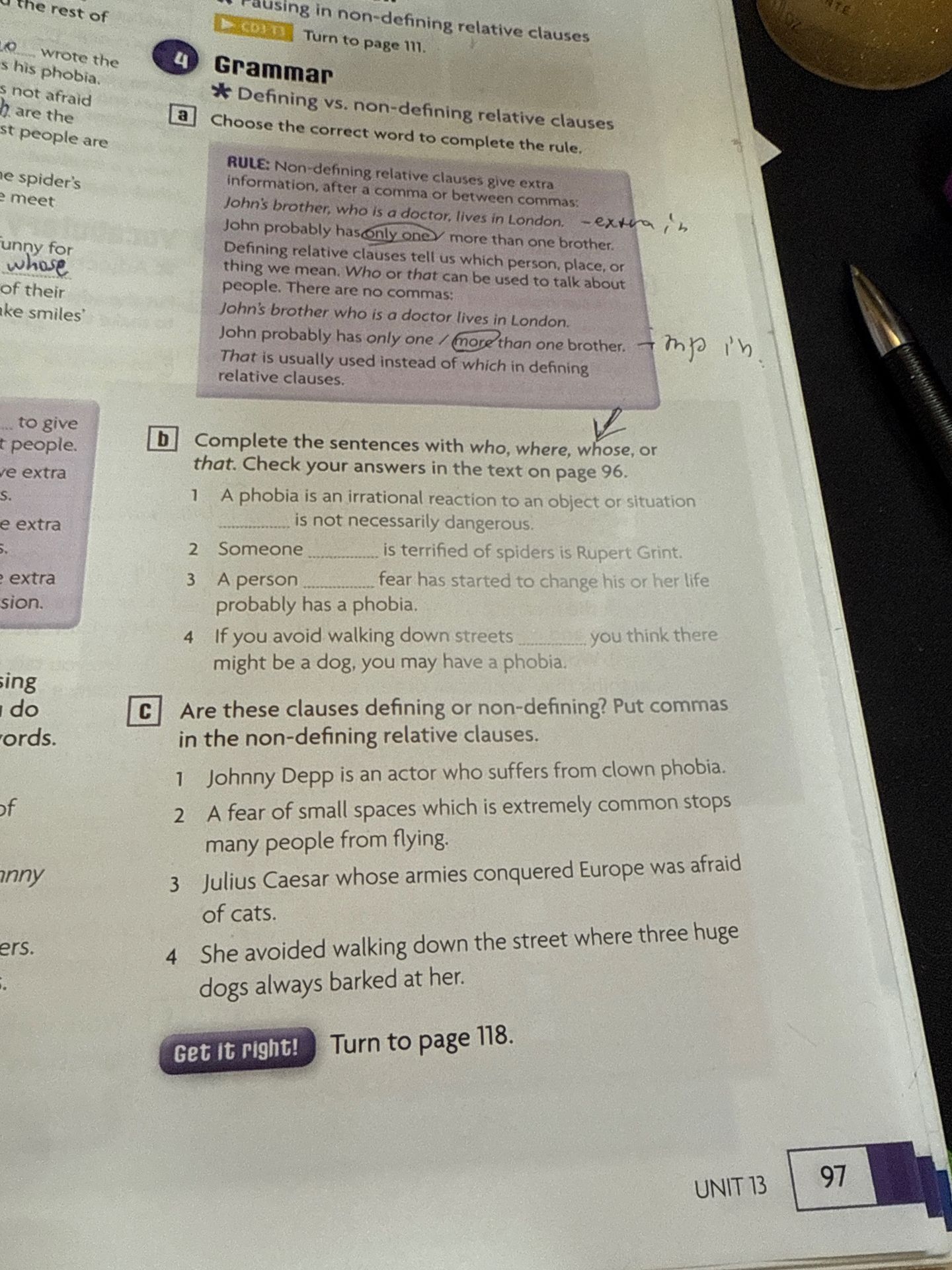
Grammar Defining vs. non-defining relative clauses Choose the correct word to complete the rule. RULE: Non-defining relative clauses give extra information, after a comma or between commas: John's brother, who is a doctor, lives in London. John probably has only one / more than one brother. Defining relative clauses tell us which person, place, or thing we mean. Who or that can be used to talk about people. There are no commas: John's brother who is a doctor lives in London. John probably has only one / more than one brother. That is usually used instead of which in defining relative clauses.
Ответ:
Решение:
В правиле нужно выбрать правильный вариант для заполнения пропусков, чтобы оно соответствовало определению определяющих и неопределяющих придаточных предложений.
Правильный вариант:
RULE: Non-defining relative clauses give extra information, after a comma or between commas:
John's brother, who is a doctor, lives in London.
John probably has only one brother.
Defining relative clauses tell us which person, place, or thing we mean. Who or that can be used to talk about people. There are no commas:
John's brother who is a doctor lives in London.
John probably has only one / more than one brother.
That is usually used instead of which in defining relative clauses.
Обоснование:
- В первом случае, если у Джона один брат, это дополнительная информация (неопределяющее придаточное).
- Во втором случае, если у Джона один брат, это определяет, о ком идет речь (определяющее придаточное).
Ответ: one.
Похожие
- Complete the sentences with who, where, whose, or that. Check your answers in the text on page 96. 1 A phobia is an irrational reaction to an object or situation __________ is not necessarily dangerous. 2 Someone __________ is terrified of spiders is Rupert Grint. 3 A person __________ fear has started to change his or her life probably has a phobia. 4 If you avoid walking down streets __________ you think there might be a dog, you may have a phobia.
- Are these clauses defining or non-defining? Put commas in the non-defining relative clauses. 1 Johnny Depp is an actor who suffers from clown phobia. 2 A fear of small spaces which is extremely common stops many people from flying. 3 Julius Caesar whose armies conquered Europe was afraid of cats. 4 She avoided walking down the street where three huge dogs always barked at her.
