
 Алгебра
 Английский
 Биология
 География
 Геометрия
 История
 Русский
 Обществознание
 Физика
 Химия
Химия Информатика
 Литература
 Математика
Вопрос:
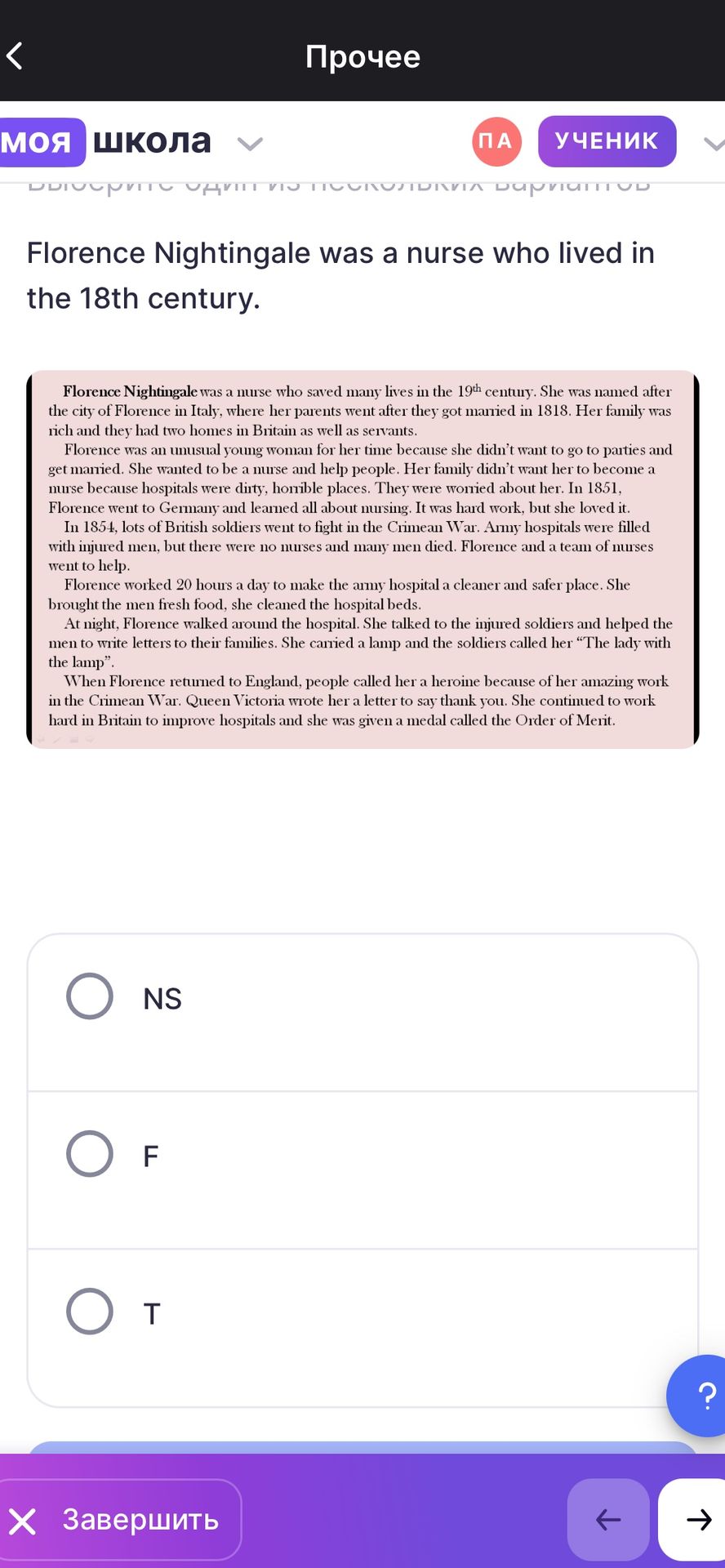
Florence Nightingale was a nurse who saved many lives in the 19th century. She was named after the city of Florence in Italy, where her parents went after they got married in 1818. Her family was rich and they had two homes in Britain as well as servants. Florence was an unusual young woman for her time because she didn't want to go to parties and get married. She wanted to be a nurse and help people. Her family didn't want her to become a nurse because hospitals were dirty, horrible places. They were worried about her. In 1851, Florence went to Germany and learned all about nursing. It was hard work, but she loved it. In 1854, lots of British soldiers went to fight in the Crimean War. Army hospitals were filled with injured men, but there were no nurses and many men died. Florence and a team of nurses went to help. Florence worked 20 hours a day to make the army hospital a cleaner and safer place. She brought the men fresh food, she cleaned the hospital beds. At night, Florence walked around the hospital. She talked to the injured soldiers and helped the men to write letters to their families. She carried a lamp and the soldiers called her "The lady with the lamp". When Florence returned to England, people called her a heroine because of her amazing work in the Crimean War. Queen Victoria wrote her a letter to say thank you. She continued to work hard in Britain to improve hospitals and she was given a medal called the Order of Merit.
Ответ:
Facts about Florence Nightingale:
- Florence Nightingale was a nurse who saved many lives in the 19th century.
- She was named after the city of Florence in Italy.
- Her family was rich and had two homes in Britain.
- Florence wanted to be a nurse and help people, not to go to parties and get married.
- Her family disapproved of her becoming a nurse because hospitals were considered dirty and horrible places.
- In 1851, she went to Germany to learn about nursing.
- In 1854, during the Crimean War, Florence and her team of nurses helped injured soldiers in army hospitals.
- She worked 20 hours a day to improve the hospital conditions, providing fresh food and cleaning beds.
- At night, she cared for the soldiers, and they called her "The lady with the lamp".
- Upon her return to England, she was hailed as a heroine for her work in the Crimean War.
- Queen Victoria thanked her in a letter.
- She continued to work to improve hospitals in Britain and was awarded the Order of Merit.
