
 Алгебра
 Английский
 Биология
 География
 Геометрия
 История
 Русский
 Обществознание
 Физика
 Химия
Химия Информатика
 Литература
 Математика
Вопрос:
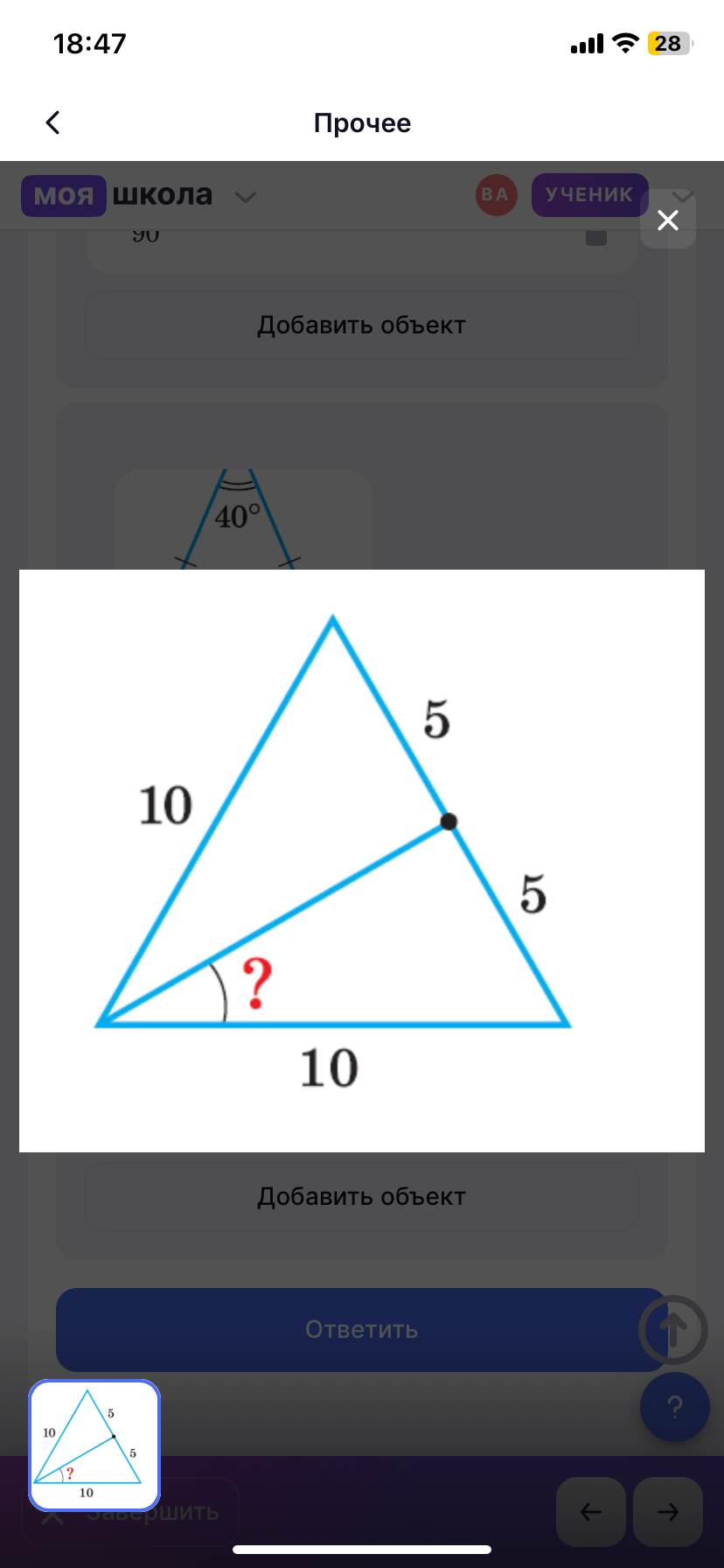
Find the unknown angle in the triangle.
Ответ:
Let's solve this geometry problem step by step.
1. **Analyze the given triangle:** We have a triangle with sides of lengths 10, 5, and 5. A line segment divides the triangle into two smaller triangles. One of the smaller triangles has sides of length 5, 5, and 10. The larger triangle has a side of length 10. The question asks us to find one of the angles.
2. **Recognize the Isosceles Triangle:** The small triangle on the right with sides 5 and 5 is an isosceles triangle. Let's call the vertices of the large triangle A, B, and C, where the side AC is of length 10, and AB = 10. Let D be a point on AC such that BD divides the triangle, and BD = 5, and DC = 5. Then triangle BDC is isosceles with BD = DC = 5.
3. **Angles in Isosceles Triangle:** In an isosceles triangle, the angles opposite the equal sides are equal. So, in triangle BDC, \(\angle DBC = \angle DCB\).
4. **External Angle Property:** The side AC = 10 and AB = 10 which make the triangle ABC an isosceles triangle too. \(\angle ABC = \angle ACB\).
Also, \(\angle BDC\) is the external angle of triangle ABD. Hence \(\angle BDC = \angle DBA + \angle DAB\). Because triangle BDC is isosceles with sides of 5, \(\angle DBC = \angle DCB\).
5. **Calculations**:
Triangle ABC is isosceles, and BD = DC = 5, then:
\(\angle DBC = \angle DCB\)
\(\angle ABC = \angle ACB\)
Since triangle ABC has sides 10, 10 and base, it is isosceles. \(\angle BAC = \angle BCA\) and \(\angle ABC = 180 - 2 \angle BAC\)
Triangle BCD has sides 5, 5 and base, it is isosceles. Then, \(\angle CBD = \angle BCD\)
6. The full angle at point C is \(\angle ACB\). Because \(\angle BCD = \angle CBD\), then \(\angle BCD = x\). Hence \(\angle CBD = x\).
Also, \(\angle ACB = \angle ABC\). Then \(\angle ABC = x + \angle ABD\). Therefore \(\angle ABD = 30^o\).
So \(\angle ABD = 30\) degrees.
**Answer:**
The measure of the unknown angle is 30 degrees.
1. **Analyze the given triangle:** We have a triangle with sides of lengths 10, 5, and 5. A line segment divides the triangle into two smaller triangles. One of the smaller triangles has sides of length 5, 5, and 10. The larger triangle has a side of length 10. The question asks us to find one of the angles.
2. **Recognize the Isosceles Triangle:** The small triangle on the right with sides 5 and 5 is an isosceles triangle. Let's call the vertices of the large triangle A, B, and C, where the side AC is of length 10, and AB = 10. Let D be a point on AC such that BD divides the triangle, and BD = 5, and DC = 5. Then triangle BDC is isosceles with BD = DC = 5.
3. **Angles in Isosceles Triangle:** In an isosceles triangle, the angles opposite the equal sides are equal. So, in triangle BDC, \(\angle DBC = \angle DCB\).
4. **External Angle Property:** The side AC = 10 and AB = 10 which make the triangle ABC an isosceles triangle too. \(\angle ABC = \angle ACB\).
Also, \(\angle BDC\) is the external angle of triangle ABD. Hence \(\angle BDC = \angle DBA + \angle DAB\). Because triangle BDC is isosceles with sides of 5, \(\angle DBC = \angle DCB\).
5. **Calculations**:
Triangle ABC is isosceles, and BD = DC = 5, then:
\(\angle DBC = \angle DCB\)
\(\angle ABC = \angle ACB\)
Since triangle ABC has sides 10, 10 and base, it is isosceles. \(\angle BAC = \angle BCA\) and \(\angle ABC = 180 - 2 \angle BAC\)
Triangle BCD has sides 5, 5 and base, it is isosceles. Then, \(\angle CBD = \angle BCD\)
6. The full angle at point C is \(\angle ACB\). Because \(\angle BCD = \angle CBD\), then \(\angle BCD = x\). Hence \(\angle CBD = x\).
Also, \(\angle ACB = \angle ABC\). Then \(\angle ABC = x + \angle ABD\). Therefore \(\angle ABD = 30^o\).
So \(\angle ABD = 30\) degrees.
**Answer:**
The measure of the unknown angle is 30 degrees.
