
 Алгебра
 Английский
 Биология
 География
 Геометрия
 История
 Русский
 Обществознание
 Физика
 Химия
Химия Информатика
 Литература
 Математика
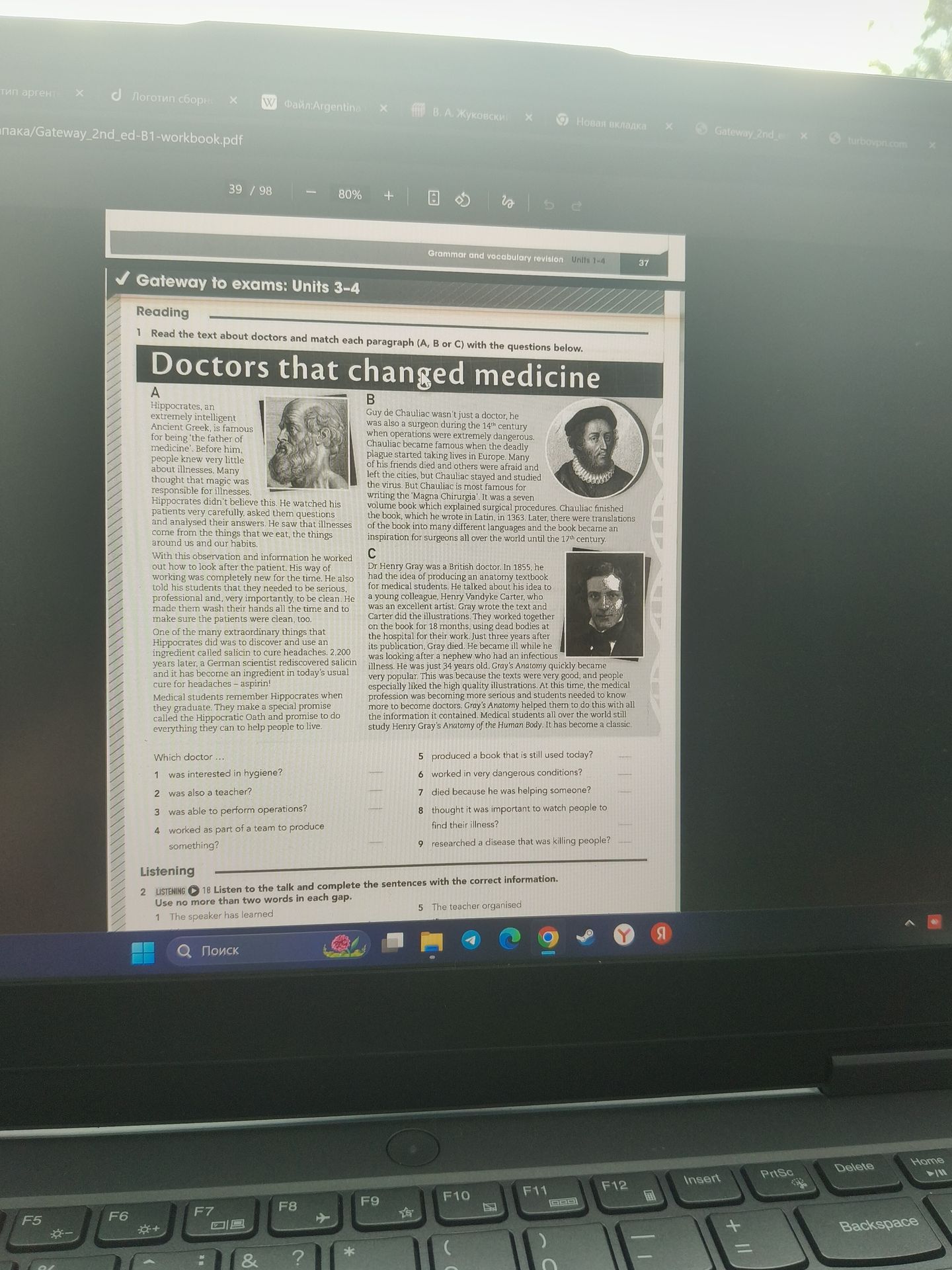
Doctors that changed medicine
Ответ:
Doctors that changed medicine
A
Hippocrates, an extremely intelligent Ancient Greek, is famous for being 'the father of medicine'. Before him, people knew very little about illnesses. Many thought that magic was responsible for illnesses. Hippocrates didn't believe this. He watched his patients very carefully, asked them questions and analysed their answers. He saw that illnesses come from the things that we eat, the things around us and our habits.
With this observation and information he worked out how to look after the patient. His way of working was completely new for the time. He also told his students that they needed to be serious, professional and, very importantly, to be clean. He made them wash their hands all the time and to make sure the patients were clean, too.
One of the many extraordinary things that Hippocrates did was to discover and use an ingredient called salicin to cure headaches. 2,200 years later, a German scientist rediscovered salicin and it has become an ingredient in today's usual cure for headaches - aspirin!
Medical students remember Hippocrates when they graduate. They make a special promise called the Hippocratic Oath and promise to do everything they can to help people to live.
B
Guy de Chauliac wasn't just a doctor, he was also a surgeon during the 14th century when operations were extremely dangerous. Chauliac became famous when the deadly plague started taking lives in Europe. Many of his friends died and others were afraid and left the cities, but Chauliac stayed and studied the virus. But Chauliac is most famous for writing the 'Magna Chirurgia'. It was a seven volume book which explained surgical procedures. Chauliac finished the book, which he wrote in Latin, in 1363. Later, there were translations of the book into many different languages and the book became an inspiration for surgeons all over the world until the 17th century.
C
Dr Henry Gray was a British doctor. In 1855, he had the idea of producing an anatomy textbook for medical students. He talked about his idea to a young colleague, Henry Vandyke Carter, who was an excellent artist. Gray wrote the text and Carter did the illustrations. They worked together on the book for 18 months, using dead bodies at the hospital for their work. Just three years after its publication, Gray died. He became ill while he was looking after a nephew who had an infectious illness. He was just 34 years old. Gray's Anatomy quickly became very popular. This was because the texts were very good, and people especially liked the high quality illustrations. At this time, the medical profession was becoming more serious and students needed to know more to become doctors. Gray's Anatomy helped them to do this with all the information it contained. Medical students all over the world still study Henry Gray's Anatomy of the Human Body. It has become a classic.
Which doctor...
- was interested in hygiene? A
- was also a teacher? A
- was able to perform operations? B
- worked as part of a team to produce something? C
- produced a book that is still used today? C
- worked in very dangerous conditions? B
- died because he was helping someone? C
- thought it was important to watch people to find their illness? A
- researched a disease that was killing people? B
Listening
2 LISTENING 18 Listen to the talk and complete the sentences with the correct information. Use no more than two words in each gap.
- The speaker has learned new facts
- The teacher organised lessons
