
 Алгебра
 Английский
 Биология
 География
 Геометрия
 История
 Русский
 Обществознание
 Физика
 Химия
Химия Информатика
 Литература
 Математика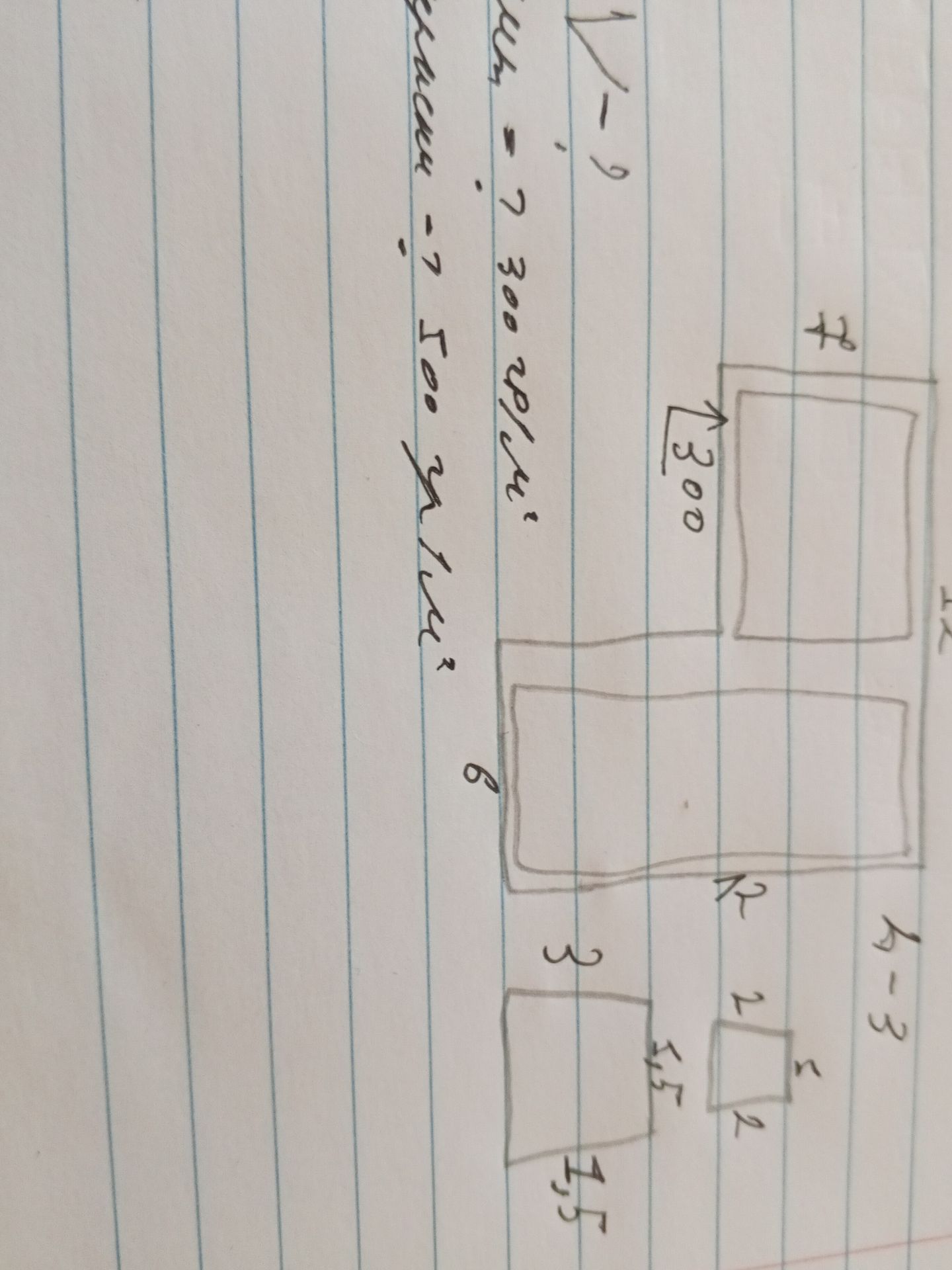
Ответ:
Solution:
The image displays several rectangles with given dimensions. We need to calculate the area of each and then sum them up.
The dimensions are interpreted as follows:
- Rectangle 1: Side lengths 7 and an unknown length, but it's next to '300'. Let's assume it's related to the 300 value. Given the context of area calculation, it is likely that '300' represents the area. However, without a clear unit for '300' and the other dimensions, we will proceed by calculating areas from explicitly given side lengths and use the '300' as a potential area for one of the rectangles if it represents a complete measure.
- Rectangle 2: Side lengths are not explicitly given, but it appears to be related to a length of '300' with an arrow pointing to it. This suggests '300' might be a dimension or an area. Given the context of the other numbers, let's assume '300' is a length and the rectangle above it has sides '7' and '300'. Area = \( 7 \times 300 = 2100 \). However, the image shows '300' in a box with an arrow, suggesting it might be a height or area. If it's an area, the dimensions are unclear. If it's a length, then the side '7' is given.
- Rectangle 3: Appears to have a side labeled '6'. Another side is not clearly given, but it is positioned below a larger rectangle.
- Rectangle 4: Appears to have a side labeled '3'. Another side is labeled '5.5'. Area = \( 3 \times 5.5 = 16.5 \).
- Rectangle 5: Appears to be a square with side lengths '2' and '2'. Area = \( 2 \times 2 = 4 \).
- There is also text '4-3' and '1-9' which might indicate subtraction or ratios.
- There is also text 'ich = ? 300 20/M²' and 'сериски - ? 500 1м²'. This implies calculations related to area and possibly price per area. Assuming '20/M²' and '500 1м²' are prices and areas, these might be separate problems or related to the rectangles. If '300' is an area in M², then '20/M²' would give a cost of \( 300 \times 20 = 6000 \). If '500' is an area in M², then the price is unknown.
Clarification needed: The image contains ambiguous labels and potentially unrelated mathematical expressions. Without clear units and explicit dimensions for all rectangles, a precise calculation of the total area is not possible. However, if we assume that the numbers next to the rectangles are their dimensions, we can calculate the areas of the clearly defined ones:
Area of Rectangle 4: \( 3 \times 5.5 = 16.5 \) square units.
Area of Rectangle 5: \( 2 \times 2 = 4 \) square units.
If we interpret the '300' with an arrow as a dimension of the top rectangle with side '7', its area would be \( 7 \times 300 = 2100 \) square units.
If '6' is a side of the third rectangle, and it's a square, its area would be \( 6 \times 6 = 36 \) square units. If it's a rectangle with an unknown second side, we cannot calculate it.
The problem statement is too vague to provide a definitive total area. The text also suggests calculations related to cost per area, which are separate from just finding the total area of the drawn shapes.
Possible interpretation based on the drawn shapes' dimensions:
Let's assume the question intends to calculate the areas of the clearly defined rectangles and sum them. From the image, we have:
- One rectangle with sides 3 and 5.5. Area = \( 3 \times 5.5 = 16.5 \).
- One square with sides 2 and 2. Area = \( 2 \times 2 = 4 \).
- A rectangle with side 7, and a dimension '300' next to it. If '300' is the other side, Area = \( 7 \times 300 = 2100 \).
- A rectangle with side 6. The other dimension is not clear.
Given the ambiguity, we cannot confidently calculate a total area. The text also includes units like 'M²', suggesting a physics or geometry problem that is not fully depicted or clearly labeled.
