
 Алгебра
 Английский
 Биология
 География
 Геометрия
 История
 Русский
 Обществознание
 Физика
 Химия
Химия Информатика
 Литература
 Математика
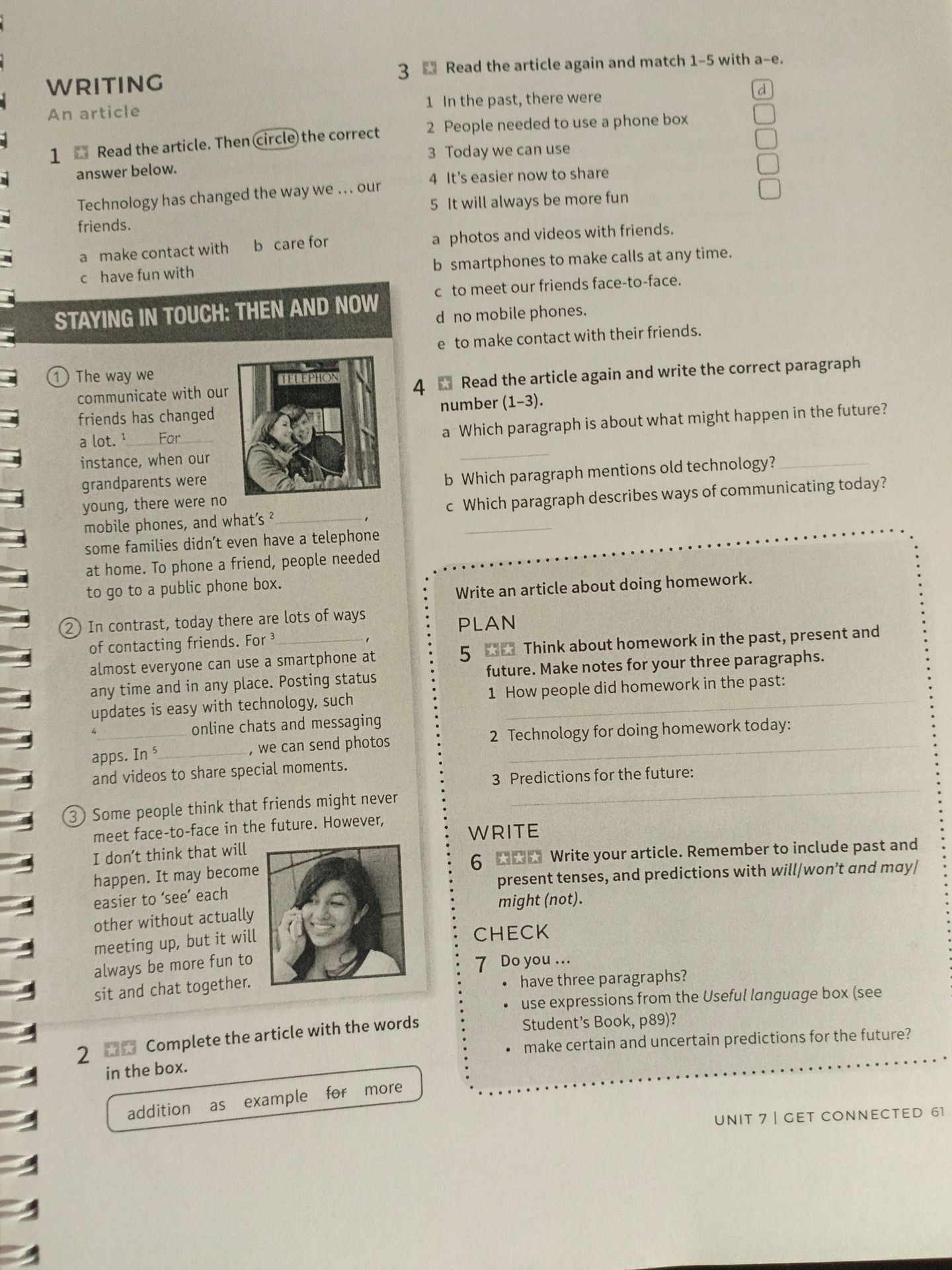
6 Write your article. Remember to include past and present tenses, and predictions with will/won't and may/might (not).
Ответ:
Homework Through the Ages
Doing homework has always been a part of schooling, but the way we approach it has transformed dramatically. In the past, homework was a much simpler affair. Students relied heavily on textbooks, encyclopedias, and their own handwriting to complete assignments. Research often meant trips to the library, and the only 'technology' involved was pen and paper. Teachers and parents were the main sources of help, and discussions about assignments happened face-to-face. This era of homework was characterized by a slower pace and a focus on rote learning and memorization.
Today, homework is inextricably linked with technology. The internet has opened up a world of information at our fingertips, making research faster and more comprehensive. Students can access online tutorials, educational apps, and digital libraries. Word processors and presentation software have revolutionized how assignments are created. Collaboration with peers and even communication with teachers can now happen instantly through online platforms. This digital age has made homework more dynamic and, for many, more accessible.
Looking ahead, the future of homework promises even more innovation. Artificial intelligence may play a significant role, offering personalized learning experiences and instant feedback. Virtual reality could create immersive environments for subjects like history or science. Learning paths will likely become even more tailored to individual student needs and learning styles. While the fundamental purpose of homework – reinforcing learning – will remain, the methods and tools we use may evolve beyond our current imagination. It's likely that homework will continue to be a blend of digital and traditional approaches, adapting to the ever-changing technological landscape.
Похожие
- 1 Read the article. Then circle the correct answer below. Technology has changed the way we ... our friends.
- 2 Complete the article with the words in the box. addition as example for more
- 3 Read the article again and match 1-5 with a-e.
- 4 Read the article again and write the correct paragraph number (1-3).
- 5 Plan: Think about homework in the past, present and future. Make notes for your three paragraphs.
- 7 Check: Do you ... have three paragraphs? use expressions from the Useful language box (see Student's Book, p89)? make certain and uncertain predictions for the future?
