
 Алгебра
 Английский
 Биология
 География
 Геометрия
 История
 Русский
 Обществознание
 Физика
 Химия
Химия Информатика
 Литература
 Математика
Вопрос:
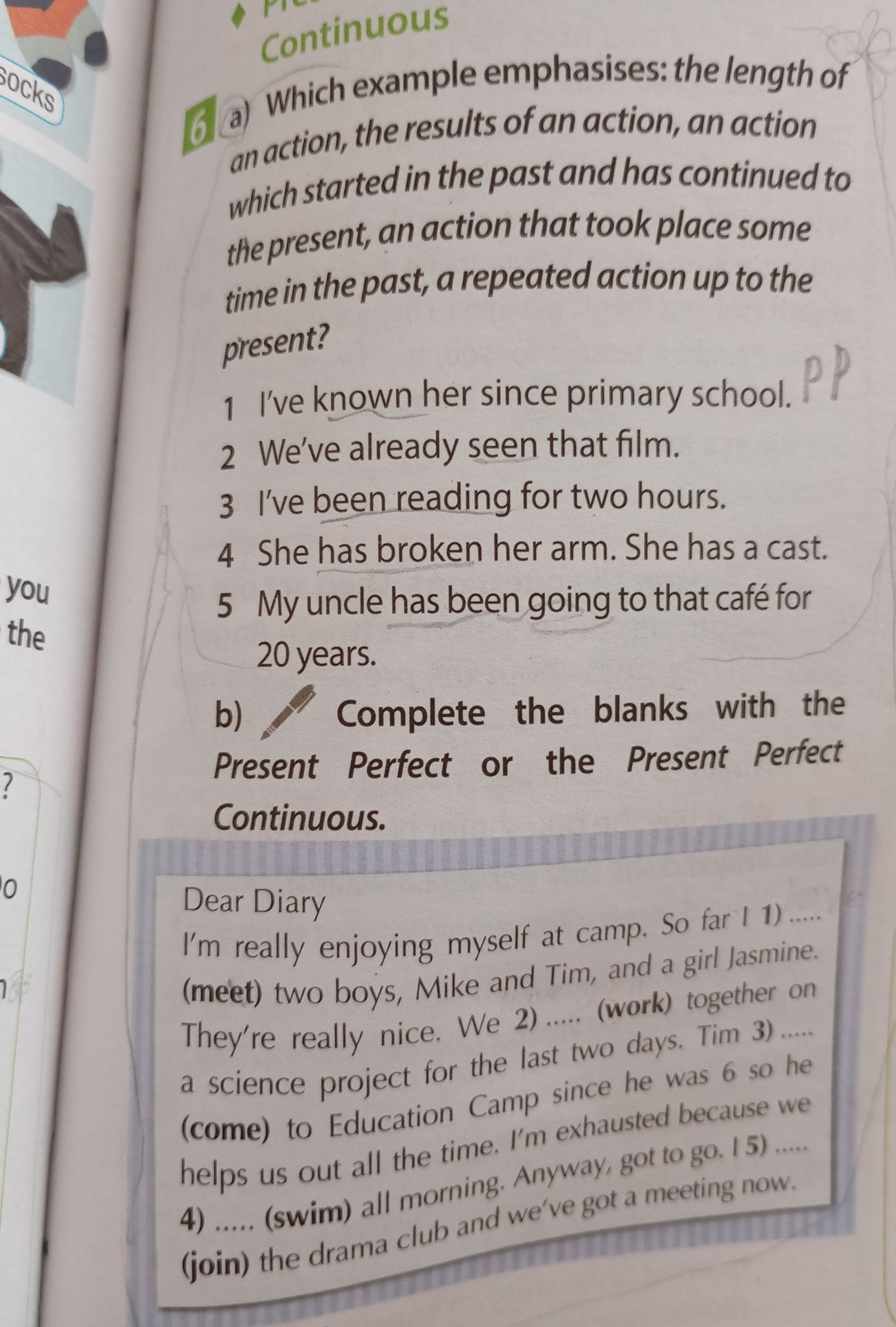
6. a) Which example emphasises: the length of an action, the results of an action, an action which started in the past and has continued to the present, an action that took place some time in the past, a repeated action up to the present?
Ответ:
Analysis of Examples:
- 1. 'I've known her since primary school.' - This sentence emphasizes an action that started in the past and has continued to the present. The present perfect tense ('have known') is used to connect a past event with the present situation.
- 2. 'We've already seen that film.' - This sentence emphasizes the result of an action. The present perfect tense ('have seen') indicates that the action (seeing the film) happened at some point in the past and has a present relevance (we don't need to see it again).
- 3. 'I've been reading for two hours.' - This sentence emphasizes the length of an action. The present perfect continuous tense ('have been reading') highlights the duration of the activity.
- 4. 'She has broken her arm. She has a cast.' - This sentence emphasizes the result of an action. The present perfect tense ('has broken') shows that the arm is broken now, and the consequence is that she has a cast.
- 5. 'My uncle has been going to that café for 20 years.' - This sentence emphasizes an action that started in the past and has continued to the present, and also suggests a repeated action up to the present. The present perfect continuous tense ('has been going') indicates an ongoing or repeated action over a period of time.
Conclusion: While several sentences touch on different aspects, sentence 5 most comprehensively covers an action that started in the past, continues to the present, and implies repetition up to the present.
