
Вопрос:

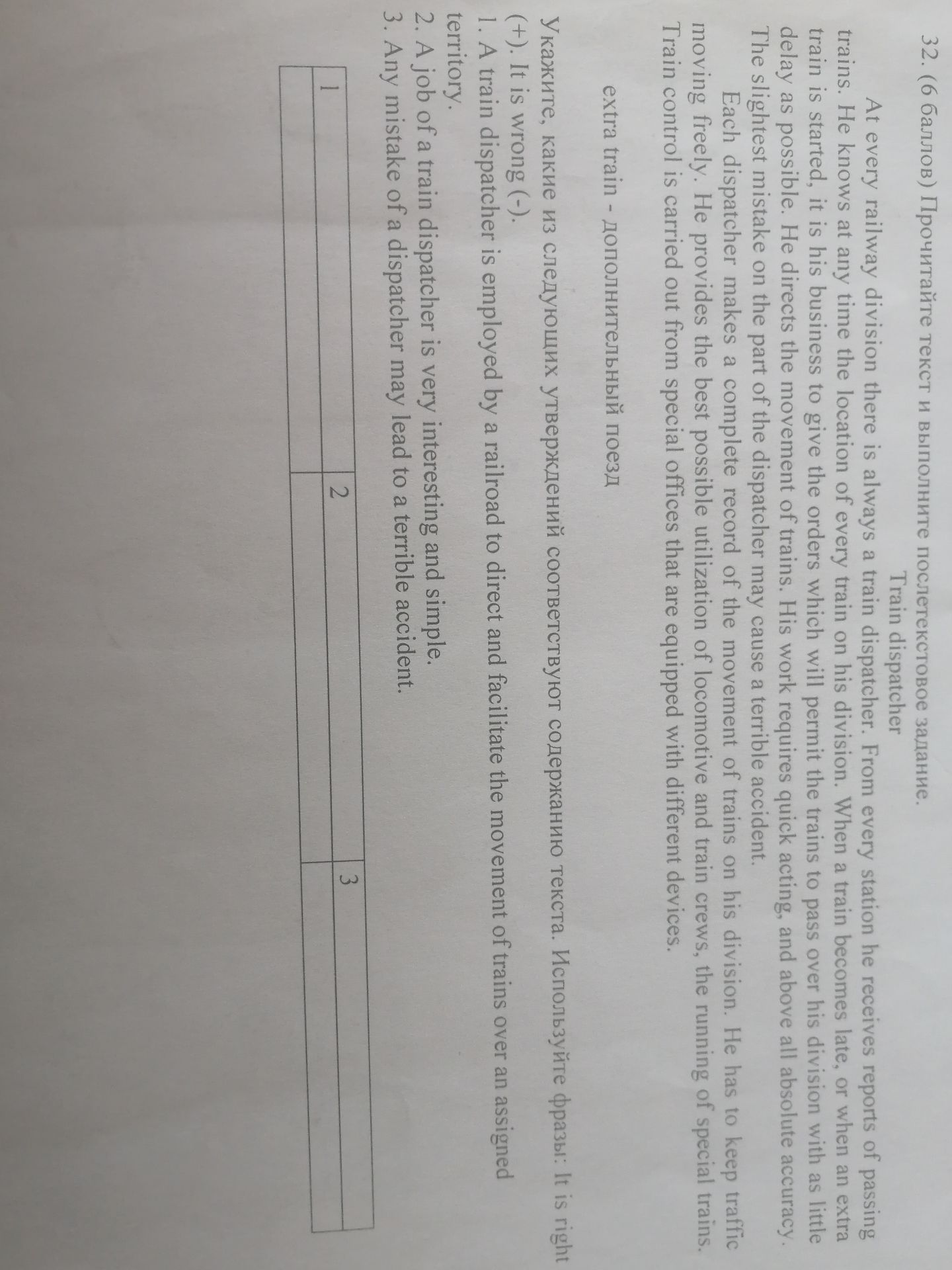
32. (6 баллов) Прочитайте текст и выполните послетекстовое задание. Train dispatcher At every railway division there is always a train dispatcher. From every station he receives reports of passing trains. He knows at any time the location of every train on his division. When a train becomes late, or when an extra train is started, it is his business to give the orders which will permit the trains to pass over his division with as little delay as possible. He directs the movement of trains. His work requires quick acting, and above all absolute accuracy. The slightest mistake on the part of the dispatcher may cause a terrible accident. Each dispatcher makes a complete record of the movement of trains on his division. He has to keep traffic moving freely. He provides the best possible utilization of locomotive and train crews, the running of special trains. Train control is carried out from special offices that are equipped with different devices. extra train - дополнительный поезд Укажите, какие из следующих утверждений соответствуют содержанию текста. Используйте фразы: It is right (+). It is wrong (-). 1. A train dispatcher is employed by a railroad to direct and facilitate the movement of trains over an assigned territory. 2. A job of a train dispatcher is very interesting and simple. 3. Any mistake of a dispatcher may lead to a terrible accident.

Ответ:

Решение:

Проанализируем каждое утверждение:

  • 1. A train dispatcher is employed by a railroad to direct and facilitate the movement of trains over an assigned territory.
    • + (It is right). В тексте сказано: "He directs the movement of trains." и "He has to keep traffic moving freely." Это соответствует данному утверждению.
  • 2. A job of a train dispatcher is very interesting and simple.
    • - (It is wrong). В тексте указано: "His work requires quick acting, and above all absolute accuracy. The slightest mistake on the part of the dispatcher may cause a terrible accident." Это опровергает утверждение о простоте работы.
  • 3. Any mistake of a dispatcher may lead to a terrible accident.
    • + (It is right). В тексте прямо сказано: "The slightest mistake on the part of the dispatcher may cause a terrible accident."

Ответ: 1 (+), 2 (-), 3 (+).