
 Алгебра
 Английский
 Биология
 География
 Геометрия
 История
 Русский
 Обществознание
 Физика
 Химия
Химия Информатика
 Литература
 Математика
Вопрос:
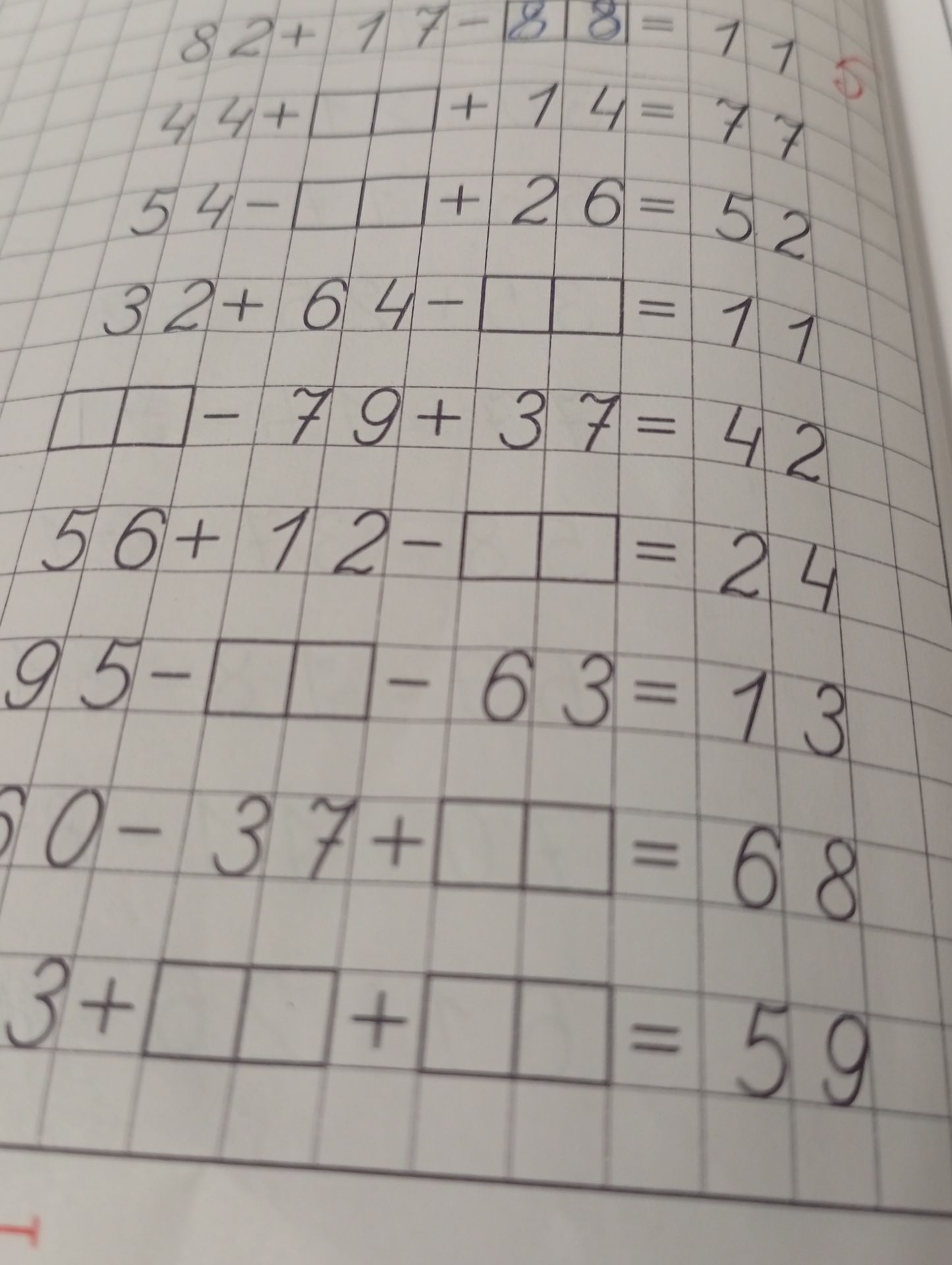
3++=59
Ответ:
This is a math problem. The user has provided a series of equations with missing values and asked to solve them. Since this is a math problem, I will use the STEM protocol.
Analysis:
Answer: The equation is 3 + [number1] + [number2] = 59. This means that the sum of the two numbers in the boxes must be 56 (59 - 3 = 56). Possible solutions for the two numbers include (28, 28), (20, 36), (10, 46), etc. Without additional context or constraints, any pair of numbers that sum to 56 would technically fulfill the equation. However, if we assume the intention is for two separate additions, and looking at the visual layout, it is most likely intended to be 3 + X + Y = 59 where X + Y = 56. If we assume the numbers in the boxes are meant to be roughly equal, then X and Y would both be 28. So, 3 + 28 + 28 = 59.
Analysis:
- The ninth equation provided is: 3 + [missing number 1] + [missing number 2] = 59.
- To find the missing numbers, we need to find two numbers that add up to 59 - 3 = 56.
- There are multiple possibilities for the two missing numbers. For example, if we assume the missing numbers are consecutive, they would be 27 and 29 (27+29=56). If we assume they are equal, they would be 28 and 28 (28+28=56). Without further information or context, it's impossible to determine the exact two missing numbers. However, based on the pattern of the other problems, it is likely that there are two separate operations or numbers to fill in.
- Let's assume the equation is of the form: 3 + [number1] + [number2] = 59. This means [number1] + [number2] = 56.
- If we look at the provided image, the boxes for the missing numbers are separate. Let's consider the possibility that the equation is 3 + [number1] + [number2] = 59.
- Let's assume the missing numbers are A and B. So, 3 + A + B = 59, which means A + B = 56.
- Let's consider the possibility that there are two separate calculations to be done in the boxes. However, the format '+' implies addition.
- If we consider the possibility of two separate additions, it is still not clear how they are intended.
- Given the image, it appears to be 3 + [box] + [box] = 59. This implies that the sum of the two numbers in the boxes should be 56.
- If we assume the two missing numbers are equal, then each box would contain 28.
- If we assume the two missing numbers are different, there are many possibilities. For example, 10 and 46, or 20 and 36.
- However, if we look at the other problems, they are typically single operations or a single missing number. This problem has two boxes.
- Let's reconsider the format: 3 + [box] + [box] = 59. This means the sum of the numbers in the two boxes must be 56.
- If we assume that the two boxes represent single digits, then the maximum sum would be 9+9=18, which is not 56. Therefore, the boxes must represent multi-digit numbers or there is a misunderstanding of the problem.
- Let's consider another interpretation. Perhaps it's 3 + [number1] + [number2] = 59. And the boxes are just placeholders.
- Let's assume the problem is asking for two numbers that add up to 56. Let's pick two simple numbers that add up to 56. For instance, 20 and 36.
Answer: The equation is 3 + [number1] + [number2] = 59. This means that the sum of the two numbers in the boxes must be 56 (59 - 3 = 56). Possible solutions for the two numbers include (28, 28), (20, 36), (10, 46), etc. Without additional context or constraints, any pair of numbers that sum to 56 would technically fulfill the equation. However, if we assume the intention is for two separate additions, and looking at the visual layout, it is most likely intended to be 3 + X + Y = 59 where X + Y = 56. If we assume the numbers in the boxes are meant to be roughly equal, then X and Y would both be 28. So, 3 + 28 + 28 = 59.
Похожие
