
 Алгебра
 Английский
 Биология
 География
 Геометрия
 История
 Русский
 Обществознание
 Физика
 Химия
Химия Информатика
 Литература
 Математика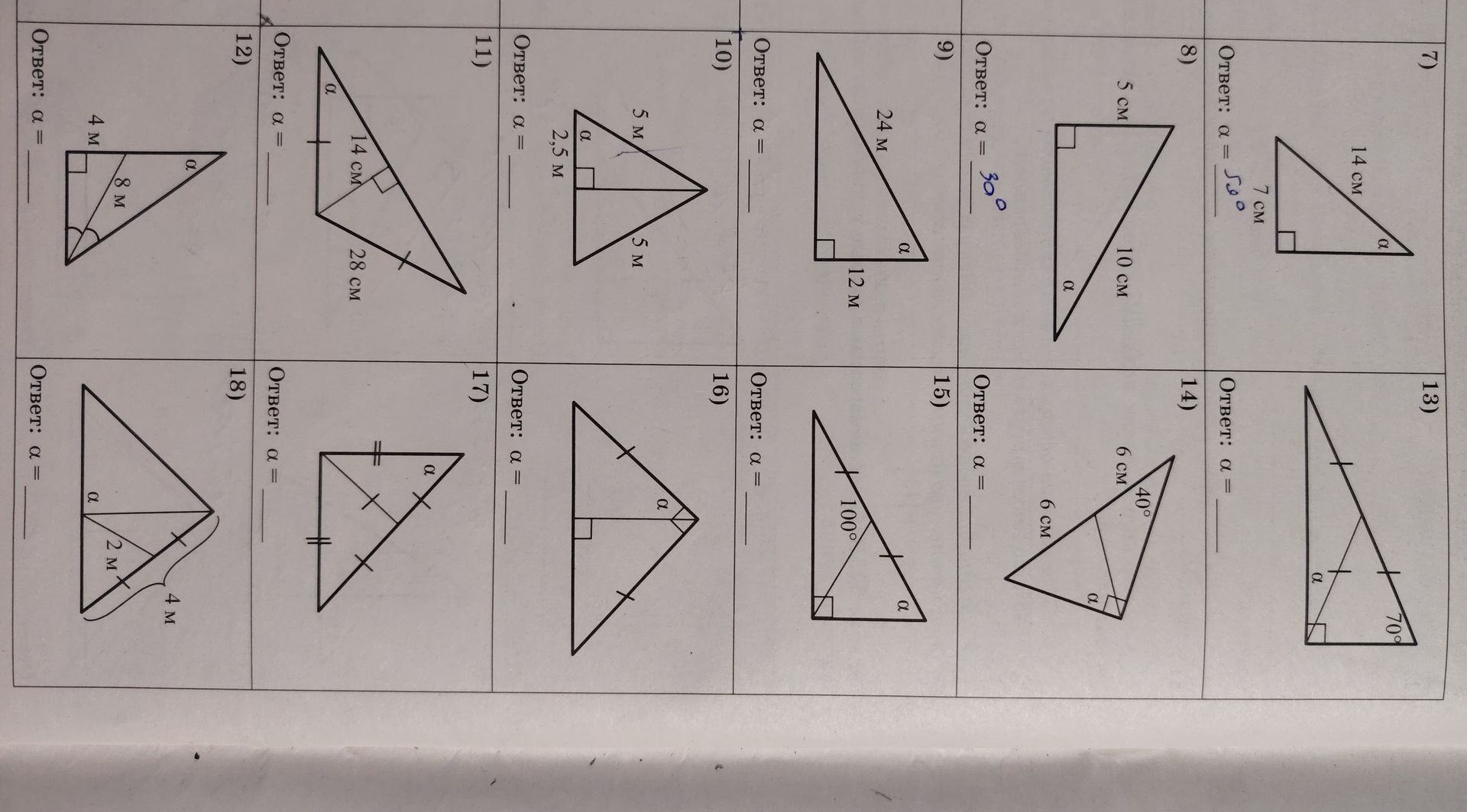
Ответ:
Solution:
The diagram shows a triangle. One side is labeled 4 m, and a segment from the opposite vertex to the base is labeled 2 m, with tick marks indicating it is equal to a part of the base. The base itself is labeled 4 m. There is also an angle \( \alpha \) marked.
It appears that the segment of length 2 m is an altitude to the base, and it bisects the base. This implies that the original triangle is isosceles, with the two sides adjacent to the vertex being equal.
However, the diagram shows that the segment of length 2 m is drawn from a vertex to the base, and it forms a right angle with the base (implied by the typical convention of such diagrams, although not explicitly marked). Also, the segment of length 2 m is shown to be equal in length to half of the base (4 m / 2 = 2 m). This means the altitude is equal to half the base.
Let the triangle be ABC, with base BC = 4 m. Let AD be the altitude, so D is on BC. AD = 2 m, and BD = DC = 2 m. Angle ADB = 90°.
In the right-angled triangle ABD, we have:
\( \tan(\alpha) = \frac{\text{opposite}}{\text{adjacent}} = \frac{BD}{AD} = \frac{2 \text{ m}}{2 \text{ m}} = 1 \)
Therefore, \( \alpha = \arctan(1) = 45^{\circ} \).
Answer: \(\alpha = 45^{\circ}\)
